MARCH 6, 2025
TWO EVENTS THAT MAY TURN OUT TO BE MUCH MORE EVENTFUL – PART 2
DONALD TRUMP COULD WELL BE ISRAEL’S TRIPLE-EDGED SWORD
On Feb 21, US President Donald Trump said he is “really” fine with any decision Israel makes as to whether to continue to a second stage of the Gaza hostage deal or return to war in Gaza.
Asked about Prime Minister Benjamin Netanyahu’s position in an interview with Fox News, Trump said: “He’s actually not torn. I mean, you know where he stands, and he would like to go in, and he’s just so angry, and he should be. If he’s not angry, then there’d be something wrong with him, frankly.”
As one Telegram news channel puts it, Trump just made it clear: he’s fine with whatever Netanyahu wants. War? Sure. Truce? Also fine. The only certainty? Israel calls the shots, and Washington bows.
Let’s cut through the noise. When asked if he’s okay with Israel plunging Gaza into further bloodshed or negotiating for hostages, Trump didn’t hesitate: “I really am.” Implication? Whatever Bibi wants, Bibi gets. Because in this administration, just like the last one, US foreign policy is dictated straight from Tel Aviv.
Trump goes on to parrot Netanyahu’s rage, calling him a “very angry man” who “should be.” Angry at what, exactly? That Israel, the region’s apartheid occupier, just got the global community to look the other way as it slaughtered over 61,000 Palestinians, including 17,492 children? Or that even after this industrial-scale massacre, Hamas is still standing, Gaza refuses to break, and the West Bank is on fire?
Then comes the obligatory Holocaust reference. The returning hostages, Trump says, looked “like a concentration camp in Germany.” Meanwhile, he purposely looks the other way when Gaza itself has been reduced to a real-life concentration camp, with its people starved, bombed, and denied medical aid, all funded by US taxpayer dollars.
Here’s the reality: Trump is selling America out to Tel Aviv, just like Biden, just like Obama, just like Bush. The “America First” rhetoric? Dead on arrival. Because when it comes to US policy, Israel comes first, always.
But there is another way of interpreting what Trump really means. And this could just make Trump’s statement on Netanyahu much more eventful. Netanyahu waltzes into Washington and walks out with a blank check, while Trump grins like a man who just sold America’s soul for a few campaign shekels.
Haaretz calls it a “bromance”, but let’s drop the euphemisms, it’s a one-way street of American subservience.
Bibi’s regime is knee-deep in Gaza’s genocide, defying international law at every turn, yet Trump, self-proclaimed champion of “America First”, hands over the keys to the US Treasury like a low-rent concierge. Billions flow, weapons keep shipping, and any pretence of US sovereignty gets flushed down the drain.
But here’s the catch: Trump’s mood swings are as volatile as a collapsing Ponzi scheme. As the geopolitical tides shift and Trump sees no more electoral gold in unconditional Zionist bootlicking, the question is will the script flip?
So, how long will the bromance last, asked Haaretz.
There is yet a third way of seeing what Trump means – he just can’t be bothered with Israel or Netanyahu. Do whatever you want … I can’t be bothered because I have so many things on my plates!
For one, he is having a lot of headaches in dealing with Ukrainian comedian president Volodymyr Zelensky after the ruckus at the Oval Office last Friday (Feb 28) beamed worldwide for all to see.
No amount of threat or intimidation could send the dictator of Ukraine cowering under the bed. Instead, after being thrown out from the White House, Zelensky went straight to that Anglo-Saxon country, UK to get consolation and support from the warmonger Keir Starmer.
Starmer wasted no time in calling an emergency summit between UK, Ukraine, Canada, Norway and 13 EU countries. At the summit Starmer said Europe “must do the heavy lifting” in ensuring a durable peace deal between Russia and Ukraine but added that the “effort must have strong US backing”.
“The UK is prepared to back this with boots on the ground and planes in the air together with others,” he told a press conference on Sunday (March 2) after the summit. Starmer also said the UK and France would lead a European effort to devise a peace plan that they would then take to the US.
Leaving the summit, Mark Rutte, Nato secretary-general, said the “debate is ongoing” over US security guarantees for Ukraine, even though Trump earlier this week said: “I’m not going to make security guarantees beyond very much. We’re going to have Europe do that.”
But this idea of European boots on the ground is a non-starter because Russia’s Foreign Minister Sergey Lavrov has already said the presence of Western European peacekeepers would escalate the conflict.
Moscow earlier warned any foreign troops in Ukraine without a UN mandate would be considered legitimate targets.
Moreover, Russia is winning the war and wants a ceasefire and the peace that follows to be based on thrashing out first the root causes of the war, thus it has a stronger say in determining how the war will end.
Zelensky’s intransigence against Trump continued even after the summit, perhaps sensing the support from Europe, he provoked Trump late Sunday (March 2) by saying that a deal to end the war between Ukraine and Russia “is still very, very far away.”
This deepened further the rift between Washington and Kiev as the following day Trump was said to be considering cutting military aid to Ukraine and expressed new outrage at Zelensky for that statement.
“This is the worst statement that could have been made by Zelensky, and America will not put up with it for much longer!” Trump barked.
“It is what I was saying, this guy doesn’t want there to be Peace as long as he has America’s backing and, Europe, in the meeting they had with Zelenskyy, stated flatly that they cannot do the job without the US. Probably not a great statement to have been made in terms of a show of strength against Russia. What are they thinking?”

Later Trump said that Zelenskyy “won’t be around very long” unless he succumbs to pressure and makes deal on the US’ terms. “It should not be that hard a deal to make. It could be made very fast,” Trump told reporters, referring to a ceasefire. “Now, maybe somebody doesn’t want to make a deal, and if somebody doesn’t want to make a deal, I think that person won’t be around very long.”
The Trump administration was reported to be drawing up a plan to restore ties with Russia and lift sanctions on the Kremlin, in a sharp turn in US policy that would alarm European allies and implies a broader rapprochement between Russia and the US.
The state and treasury departments were said to be tasked with drawing up a list of sanctions that the US could lift as part of the administration’s broad talks with Moscow on improving diplomatic and economic relations, Reuters reported.
Also, the Wall Street Journal reported on Monday (March 3) the Trump administration had stopped financing new weapons sales to Ukraine and was considering freezing weapons shipments from US stockpiles, in what would be a devastating blow to Ukraine’s ability to continue to defend against the Russian invasion.
The other big headache the US is facing with Zelensky is the minerals deal which was supposed to be signed last Friday (Feb 28) but was aborted because Zelensky was thrown out of the White House before the deal could be signed due to his intransigence at the Oval Office.
Trump is demanding that Ukraine pays compensation for all the financial assistances the US has given it in the Ukraine war, amounting to some USD500 billion, and the mineral deal is supposed to be part of that compensation.
But according to sources Zelensky cannot sign the minerals deal with the US, as he has already sold the minerals to the UK in a 100 year deal just four days before Trump’s inauguration.
And in a rift between the two Anglo-Saxon countries, the US has ordered the UK NOT to share American military intel with Ukraine, the DailyMail reported.
The other thing that occupies Trump’s mind is the economy. Since the economy always gets a bit of a raw deal here, Trump’s economic policy is already having an effect – even if some people don’t like it.
Trump needs a devaluation of the dollar in order to reindustrialize and repatriate jobs. If there is fear of a global conflict, the opposite will happen, as the dollar is (unfortunately) still a safe haven for many market participants.
In addition, the Fed is also tightening the money supply. However, peace policy as well as Trump’s tariff policy are good for a dollar devaluation, and to boot he doesn’t need the central bank for this.
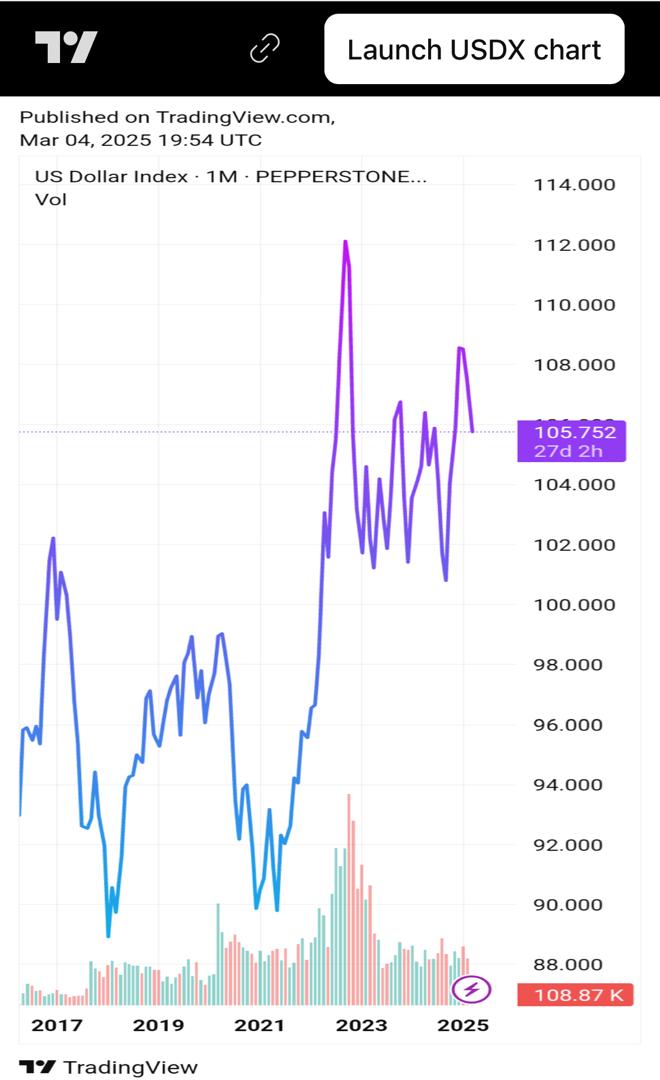
This can all be seen in the dollar index, which measures the strength (or weakness) of the USD. It exploded in 2022 and has now fallen slightly since Trump took office.
But if Trump carries the tariff war too far, he risks a global economic meltdown – again the opposite will happen, as the dollar is still a safe haven for many market participants.
So with all these things on his plates, it makes more sense that he just can’t be bothered with Israel or Netanyahu, do whatever you want – that seems to be his message to Netanyahu.
Meanwhile as phase 1 of the Gaza ceasefire is about to end on March 2, Israeli media reports on Feb 27 that calls are underway between Washington and Tel Aviv to extend the first phase for several weeks.
But Hamas has rejected this, saying that the ceasefire agreement signed by Hamas and Israel clearly stipulates March 2 as the end of phase 1, and phase 2 will begin the next day. The Palestinian Resistance is accusing Israel of dragging its feet to begin Phase 2.
Netanyahu is considering a brief resumption of fighting against Hamas to pressure it into making further concessions, according to an Israeli television report aired Saturday (March 1) as he held high-level deliberations on the stalled negotiations to advance to the second stage of the hostage-ceasefire agreement in Gaza.
Hamas has rejected Israel’s proposal to extend the first, 42-day stage of the deal, which formally expires Saturday night, insisting that the deal proceed with phase two, which Israel has largely refused to negotiate for the past month.
During the first phase, 33 Israeli hostages were released, eight of them dead, in exchange for nearly 2,000 Palestinian prisoners. Five Thai nationals held hostage in the Gaza Strip were freed separately.
With the ceasefire expected to lapse at midnight, Netanyahu and Defence Minister Israel Katz will meet Sunday (March 2), along with other security officials, to discuss preparations for a potential resumption of fighting in Gaza and a review of all potential war fronts, Channel 12 news reported.
Despite the Israeli PM’s reluctance in holding talks regarding phase two of the hostage deal, he also met with top aides on the continuation of hostage talks, according to Channel 13 news, thus exhibiting a schizophrenic tendency.
The second phase is meant to include the release of remaining hostages and steps leading to a permanent end to the war sparked by Hamas’s October 2023 attack, including a withdrawal of Israeli troops from the Strip.
Up till today, while Hamas is standing its ground, Netanyahu dithered on resuming fighting against Hamas despite earlier mulling it and in spite of the greenlight given by Trump for him to do whatever he wants.
Then came a proposal from US Special Envoy to the Middle East Steve Witkoff for a temporary ceasefire with Hamas in Gaza for the Ramadan and Passover holidays. The Muslim holy month of Ramadan began on Saturday (March 1) and will last until March 30, while the Jewish Passover week will be marked from April 12 to 20.
Based on Witkoff’s proposal, on the first day of the extended ceasefire, about half of the 59 living and dead Israeli hostages held by Hamas in Gaza would be returned. At the end of the outline period, if an agreement is reached on a permanent ceasefire, the rest of the hostages would be released.
Witkoff proposed extending the ceasefire after he felt that bridging the parties’ positions to end the war was impossible at this stage and that more time was needed for talks on a permanent ceasefire.
While Netanyahu immediately clutched to this proposal like a drowning man, Hamas seems to not want anything to do with this proposal.
In a unilateral statement and in violation of previous agreements, the Israeli PM calls on Hamas to release half of the prisoners without negotiations on the second round of the ceasefire.
In response to Netanyahu, Hamas spokesman Hazem Qassem emphasized that the release of the remaining Israeli prisoners in Gaza will only take place through negotiations related to the second phase of the ceasefire agreement and within the framework of a prisoner exchange.
He added: “Based on the agreement, the second phase of negotiations should begin on the 16th day of the ceasefire, and we are committed to this process.” Qassem also warned that by trying to extend the first phase, the occupying regime intends to return the situation to zero and release its prisoners without stopping the war.
Meanwhile, in an unprecedented development, 
White House press secretary Karoline Levitt confirmed during the daily briefing that the US has been holding direct talks with Hamas.

Levitt said Israel was consulted about the talks and stressed they are ongoing. She said President Trump believes “it is the right thing for the American people” and added, “There are American lives on the line.”
However, according to Axios, the Israelis learned about aspects of the talks through other channels.
Trump’s envoy Witkoff postpones his visit to the region and states that Israel must maintain the ceasefire agreement until he returns, which amounts to an extension of the ceasefire until Witkoff comes to resolve the crisis.
Responding to all these developments, Advisor to the Head of Hamas’s political bureau said the meeting with the US administration is beneficial for stability in the region.
“We welcome any change in the thinking of the US administration and call on it to take a serious step in dealing with the movement. There is a change in the US political discourse that differs from previous administrations and there is a trend to find a comprehensive deal in the region.”
The discussions, facilitated by Qatari intermediaries, have reportedly been ongoing for weeks but became more evident in early March 2025. This is the first time in decades that the US negotiated directly with Hamas, a significant departure from US policy, which ruled out direct engagement with the group that it designated a Foreign Terrorist Organization (FTO) in 1997.
Axios, which first reported the talks, also said the discussions included a possible broader agreement to release all remaining captives and establish a long-term truce.
The Wall Street Journal reported that talks took place last month in Doha and led to the release of Sagui Dekel Chen, an Israeli-American dual citizen, on February 15.
Adam Boehler, the US presidential envoy for hostage affairs, led the direct talks with Hamas.
He was also a key negotiator on the Abraham Accords during Trump’s first term, working to expand Israel’s normalisation with the Arab world.
Very strangely, following the report, Trump issued a strong warning to Hamas in a social media post yesterday (March 5) demanding the immediate release of all captives.
He addressed the people of Gaza directly. “Also, to the People of Gaza: A beautiful Future awaits, but not if you hold Hostages. If you do, you are DEAD! Make a SMART decision,” Trump wrote.
He said he would send Israel “everything it needs to finish the job”, and warned, “Not a single Hamas member will be safe if you don’t do as I say.”
That is vintage Trump, perhaps trying to deflect whatever anger Netanyahu has for this unprecedented move of holding direct talks with Hamas.
Hamas responded to Trump’s threat with a COOL reaction – Hamas spokesman, Hazem Qassem said they “complicate matters regarding the ceasefire agreement and encourage [Israel] to refrain from implementing its terms. Hamas implemented all its obligations under phase one, but Israel is avoiding entering phase two.
“The US administration is required to pressure the occupation to enter negotiations for the second phase.”
So who will blink first? Will Netanyahu resume the Gaza war, and if he does, will it take another 15 months or more for him to fight Hamas without again scoring a strategic victory?
Are Hamas and the other Palestinian Resistance fighters ready to face off Netanyahu? That will be another story to tell …
Just saying …
Recent posts
- Vol 4 No 51: The economy and US presidential election: Ticking time bomb for Israel’s defeat [PDF]
- Vol 4 No 52: Israel and its four fairy tales on Hamas [PDF]
- Vol 4 No 53: Unprecedented Iran’s slap on Israel’s face that has many firsts [PDF]
- Vol 4 No 54: The world in chaos [PDF]
- Vol 4 N0 55: Panic and despondency before the storm [PDF}
- Vol 4 No 56: The Iranian Art of War is driving Israel on the edge of an economic and military abyss [PDF]
- Vol 4 No 57: A watershed Brics Summit in Kazan, Tatarstan [PDF]
- Round-up of world news (July 29)
- Round-up of world news (August 12)
- Round-up of world news (August 26)
- Round-up of world news (September 2)
- Round-up of world news (October 17)
- Breaking News (23/10)
- Breaking News (24/10)
- Round-up of world news (October 29)
- Breaking News (31/10)
- Round-up of world news (November 4)
- Round-up of world news (November 12)
- The Gaza Ceasefire: Beyond the Headlines
- Eschatology + Seerah: Understanding the Gaza War through the lens of Isra’ Mi’raj
- TWO EVENTS THAT MAY TURN OUT TO BE UNEVENTFUL
- Sighting crescent moon with naked eye a religious obligation