
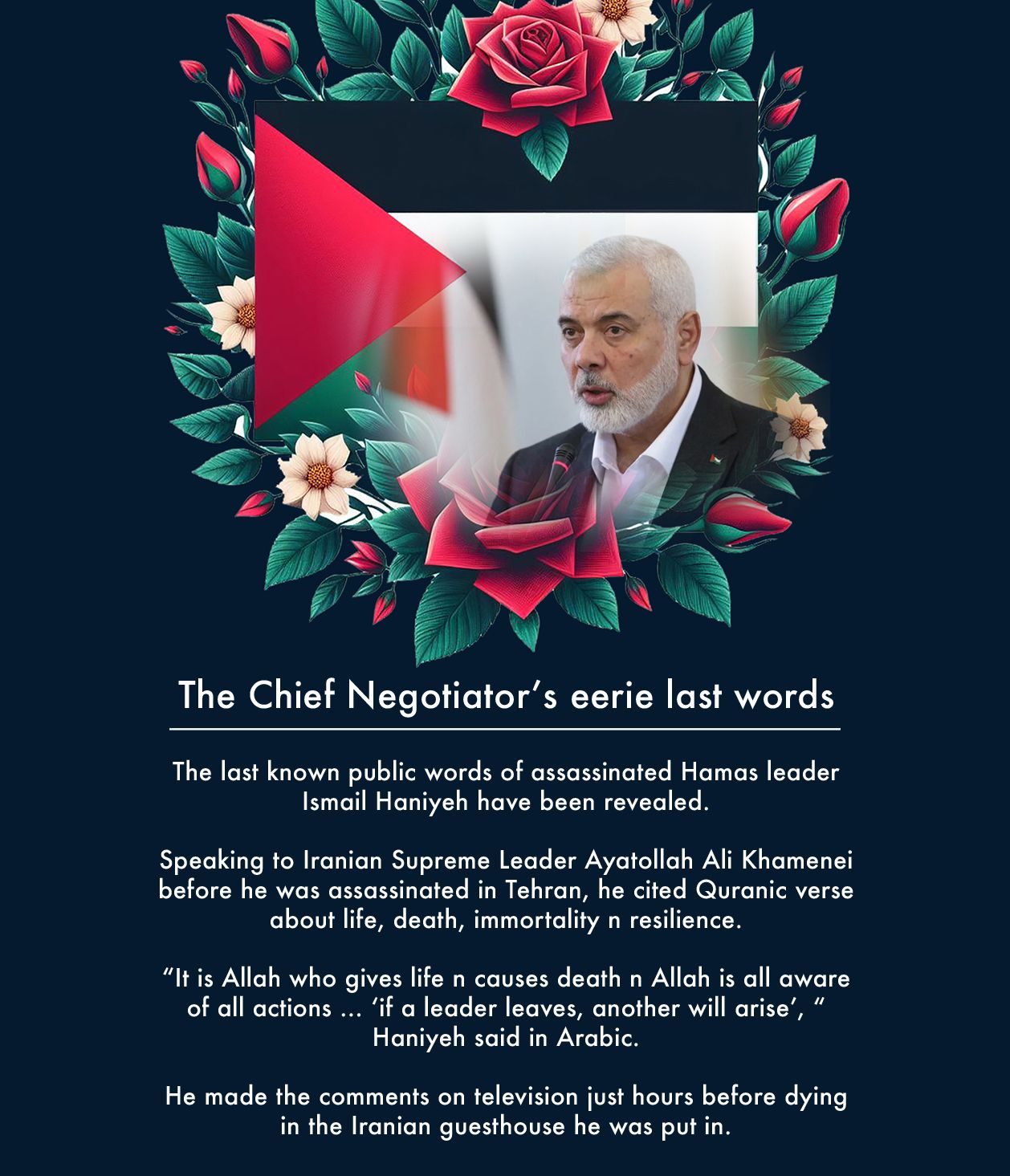
- The long-awaited response of retaliation by Iran and the Axis of Resistance to the assassinations of Hamas Politburo Chief, Ismail Haniyeh and Hezbollah Commander Fuad Shukr only serves to highlight the brilliant Iranian Art of War in action.
- Iran first went through the due diligence of teaching the world that Israel’s assassination of Haniyeh on Iranian soil is a breach of its sovereignty and international law by going through the motion of bringing the issue to the UN Security Council (UNSC).
- UNSC members on August 1 condemned the assassination of Haniyeh in the Iranian capital Tehran, at an emergency session convened at the request of Iran, which was supported by Russia, Algeria and China.
- Speaking at the session, Chinese Ambassador Fu Cong said China strongly condemns the assassination of Haniyeh.
- Calling the incident “a blatant attempt to sabotage peace efforts,” Cong stressed that “China is deeply worried about an exacerbation of the upheaval in the region that this incident may trigger.”
- Similarly, Algeria’s envoy to the UN, Amar Bendjama, said: “We are on the precipice of catastrophe,” adding that Israel’s attack was “an act of terror” that violated international law and the sovereignty of Iran.
- “This is not merely an attack on one man. It is a vicious assault on the very foundations of diplomatic relations, the sanctity of state sovereignty and the principles that underpin our global order,” he said.
- Bendjama strongly condemned the “terrorist act perpetrated by the Israeli occupying power.”
- Saying that Israel’s “blotchy, scorched-earth policy” is leading to a “tide of violence flooding Gaza, the West Bank, Yemen, Lebanon, Syria and now the Islamic Republic of Iran,” he asked: “Where will this madness end?”
- He also called on the international community not to remain silent “as innocent blood is spilled and international law is shredded to pieces. With utmost urgency, we call for an immediate, unconditional ceasefire in Gaza and the lifting of the inhuman Gaza blockade.”
- Echoing Algeria, Dmitry Polyansky, Russia’s First Deputy Permanent Representative to the UN, reiterated his country’s condemnation of the assassination of Haniyeh, adding the consequences of the attack are “dangerous” for the entire region.”
- This is a serious blow, primarily to mediation negotiations between Hamas and Israel focused on a ceasefire in the Gaza Strip, and Ismail Haniyeh was a direct participant in this. We must all understand this,” Polyansky said.
- Saying the attack is an attempt to drag Iran into “an atmosphere in the region that is already at the boiling point,” the Russian envoy said “the heinous practice of targeted assassination of high-profile political and military figures is bringing the Middle East to the brink of a region-wide war.”
- Next, Iran asked for the convening of a meeting of the Organisation of Islamic Cooperation (OIC) whose members consist of all Muslim countries in the world to get its blessing that it is justified and within Iran’s right to retaliate against the murder of Haniyeh in Tehran.
- Once this blessing was duly given by the OIC, preparation for the Axis’ Special Military Operation (SMO) coordinated by Iran went into full gear.

- The planning is done based on several adages in warfare, namely success in war depends on surprise, and surprise usually depends on deception, and there should not be a repetition of a winning formula.
- In one go this means all the tactics and strategies in the winning move on April 13 in which Iran became the first state actor in the world to strike Israel on its very soil would not be repeated.
- In the April 13 strike on Israel, which was in response to the Israeli bombing of its consulate in Damascus, thus breaching international laws, Iran made it clear it did not have any intent to destroy Israel or kill anyone in Israel through the retaliation.
- It is Iran trying to reassure Israel and the US that there is no existential threat to Israel in its April 13 strike, and the strike is merely to warn Israel that Iran has the capabilities and capacities to attack deep inside Israel’s territories despite the latter being defended by the US and its allies with their sophisticated gadgets and weaponries.
- Ever since Operation Al-Aqsa Flood was launched last October, Israel has developed a siege mentality in perceiving itself as a country facing an existential threat, which has, therefore, increased its willingness to accept greater risks.
- But a month after Op Al-Aqsa Flood, Politico cited former Mossad director Tamir Pardo as blaming prime minister Benjamin Netanyahu and US president Joe Biden for fuelling the perception that Israel was facing an existential crisis.
- That shift in mindset became evident in Israel’s attack on the Iranian consulate in Damascus on April 1 when a day after the attack, Israeli Defence Minister Yoav Gallant said Israel’s goal is to “act everywhere, every day, to prevent the force build-up of our enemies”.
- This statement of Gallant clearly shows someone who is afraid of his own shadow and thus is infected with the “disease” of a siege mentality because there’s simply no party that is interested in driving Israel out of existence.
- The Gaza war or for that matter Operation al Al-Aqsa Flood launched by Hamas is a resistance movement that has as its primary objective not so much the end of Israel as a state, but to end the Israeli occupation of Palestine so that an independent sovereign Palestinian state can exist.
- Tel Aviv’s decision-making process is very much influenced by two key factors: first, the US, and second, the deep state or establishment within Israel.
- These elements can either enhance rationality or reduce caution in risk acceptance, particularly among Israel’s influential extremists.
- But Iran’s Operation True Promise in mid-April, which showcased the Islamic Republic’s military capabilities, has somewhat constrained Israel’s risk-taking behaviour.
- Concerns such as the potential for a full-scale war and its associated high costs have become more pressing, as highlighted by Major General Yahya Rahim Safavi, former chief commander of the Islamic Revolutionary Guard Corps (IRGC) when he emphasised Iran’s missile capabilities during the retaliatory operation.
- “During Operation True Promise, more than 100 missiles were launched towards Israel in just 100 seconds, at a rate of one missile per second. The US, Israel, and their regional allies never anticipated that Iran could execute such a precise and large-scale operation,” the former IRGC chief said.
- General Safavi who’s also the top military advisor to Iran’s Supreme Leader Ali Khamenei, elaborated on the international response, noting:
- “The Americans mobilized Centcom and Eucom forces to the Mediterranean Sea, deploying over 250 fighter and support aircraft and ships equipped with anti-missile systems. They also utilized all their radars and those of some regional countries. Recently, the Pentagon released a report on Operation True Promise, acknowledging Iran’s capabilities.”
- Emphasising Iran’s defensive stance, the general stated: “We do not seek territorial expansion, but if any country, including the US attacks us, we are capable of responding across the seas.”
- Reflecting on the historical context, General Safavi remarked, “Just as the young generation of Iran under the leadership of Imam Khomeini performed miracles during the Iran-Iraq war, today’s generation, under the leadership of the Leader of Islamic Revolution Ayatollah Seyyed Ali Khamenei, will also achieve remarkable feats. One such feat was Operation True Promise, which astonished both the world and our enemies.”
- So the awaited retaliation by Iran would be vastly different both in term of scope and magnitude from Operation True Promise launched against Israel in April.
- Moreover all these and the need for an element of surprise to ensure success in the SMO requires time, and hence Iran is taking the time of its own choosing to retaliate.
- But the aggressor streak that is in Israel’s gene is so impatient in wanting Iran to get it over and done with in its retaliation that Israel foolishly went public with the idea that it could conduct a pre-emptive strike on Iran if it dilly dallies with the retaliation.
- Now there are at least two reasons why Israel wants Iran to retaliate rather quickly.
- Firstly, Israel reckons that a quick retaliation by Iran will result in a quick entry of America in the conflict between Israel and Iran.
- For donkey years and decades, Israel has this objective which it has failed to achieve – a war with Iran on one side, and Israel together with the US on the other side.
- This one sided war is reinforced when on two occasions in 2023 before Operation Al Aqsa Flood was launched, joint war games and exercises conducted by US and Israel had shown that Israel would be beaten hollow by Iran in a war without US’ participation.
- That is why Israeli prime minister Benjamin Netanyahu’s mind is full of escalation as he thinks, sleeps and dreams everyday conjuring up escalation moves in order to create this one sided war between Israel and US on the one hand, and Iran on the other hand.
- He has tried everything including killing more than 40,000 Palestinian civilians, mostly women, children, babies and the elderly, and assassinating IRGC personnels in Syria and Lebanon, and yet the one sided war with Iran still does not materialise.
- But when he recklessly bombed the Iranian consulate in Damascus on April 1, he thought that his dream war with Iran has finally come to fruition with the participation of the US.
- However he was very disappointed then when the US made it clear that it didn’t want a war with Iran, and so he has to eat humble pie and be just contented with the US’ commitment to defend Israel if Iran retaliated to the bombing of its consulate, which Iran did with spectacular success on April 13.
- Secondly, a quick retaliation by Iran would save Israel from having to face an attrition war in the form of the destruction of its economy and with the entire segments of Israeli society and institutions living in ‘nerve-wrecking’ period anticipating the Iranian response.
- In other words, the long overdue retaliation by Iran whose timing is not known to Israel creates a psychological warfare scenario that puts Israel on the losing end.
- In fact, veteran journalist Pepe Escobar describes the waiting game played by Iran as actually a masterclass of strategic ambiguity to rattle Israel’s nerves, and this will persist for some more time.
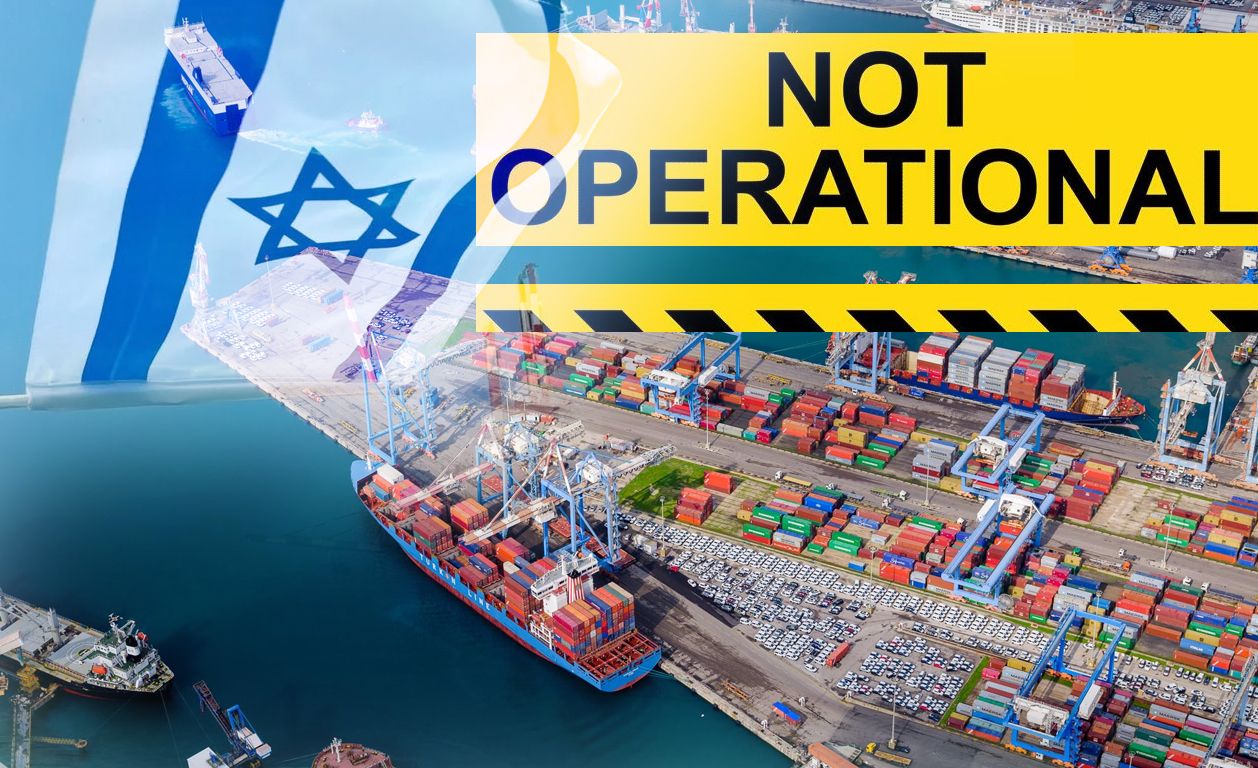
- Already Israel is reportedly suffering from a de facto naval blockade imposed by Iran and Hezbollah, according to a recent report from the Israeli news outlet Walla!
- This blockade, dubbed as a strategic move without missiles has already caused severe operational paralysis in key Israeli ports, and experts warn that the situation could deteriorate further if the ongoing war escalates.
- The report details how this blockade has been strategically enforced by Iran and Hezbollah as a pre-emptive measure in anticipation of the expected responses to the assassination of martyrs Fuad Shukr and Ismail Haniyeh.
- Despite no missiles being fired, the blockade has effectively crippled Israel’s maritime trade routes.
- This is separate from the ongoing Yemeni operations in the Red Sea since November where the port of Eilat has been rendered non-operational.
- As a result, shipments destined for Eilat have been redirected to the ports of Haifa and Ashdod.
- However, with insurance costs skyrocketing and the increasing reluctance of shipowners to send vessels to these ports, the crisis is deepening.
- Rami Zafa, the head of Israel’s maritime shipping office, warned that “40% of general cargo ships are now refusing to sail towards Israel” due to the high risks and costs associated with the blockade.
- Additionally, “15% of oil tankers have ceased operations in Israel” and large container ships that previously serviced Israeli ports are now avoiding them.
- The only shipments arriving are those transported on smaller, more expensive vessels.
- The burden of these disruptions has largely shifted to the Ashdod port.
- However, even here, the situation is dire, with shipowners increasingly hesitant to send their vessels into what they see as a dangerous environment.
- Zafa emphasized that “the ships entering Israel’s economic maritime zone cannot escape,” as they would be prime targets for missile attacks from Hezbollah or Hamas.
- In light of these conditions, Zafa has called on Transportation Minister Miri Regev and Finance Minister Bezalel Smotrich to take immediate action to bolster the ports’ readiness for war.

- He also urged authorities to address the severe shortage of workers at the Ashdod port, where many employees have been called up for reserve duty.
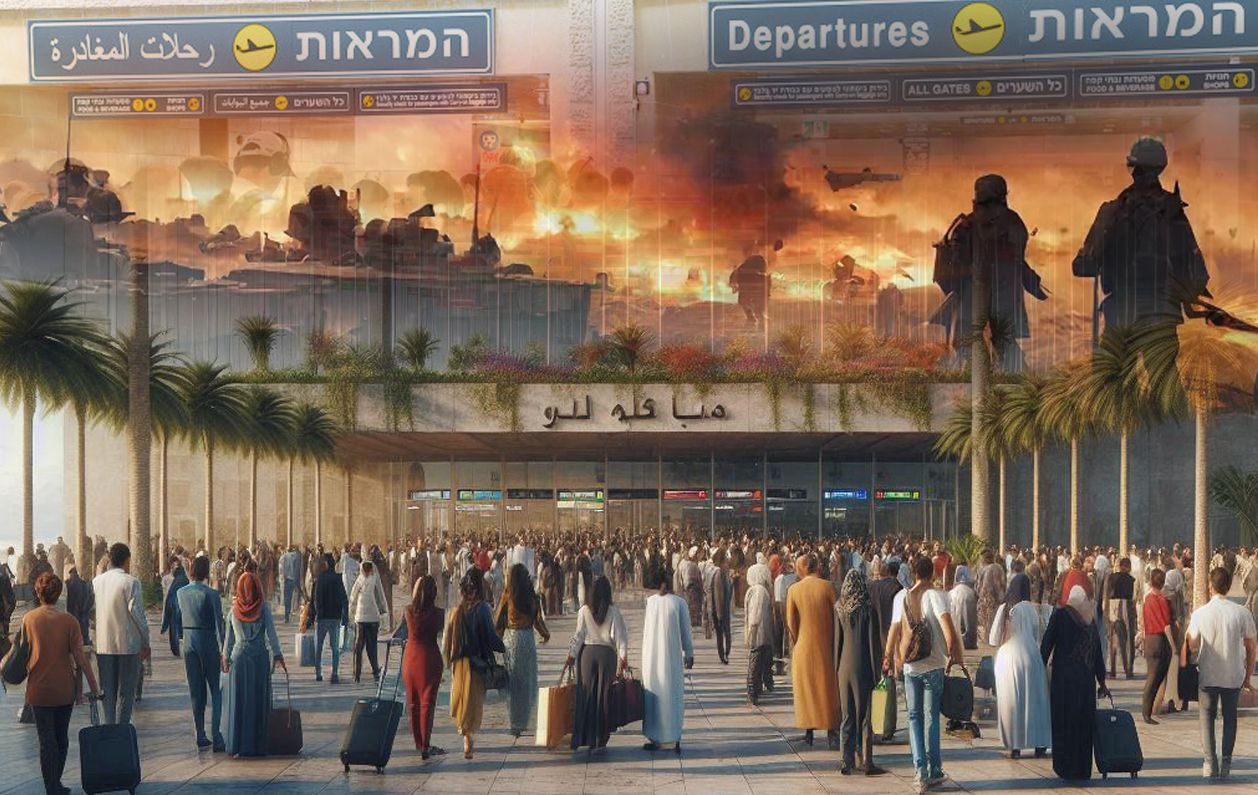
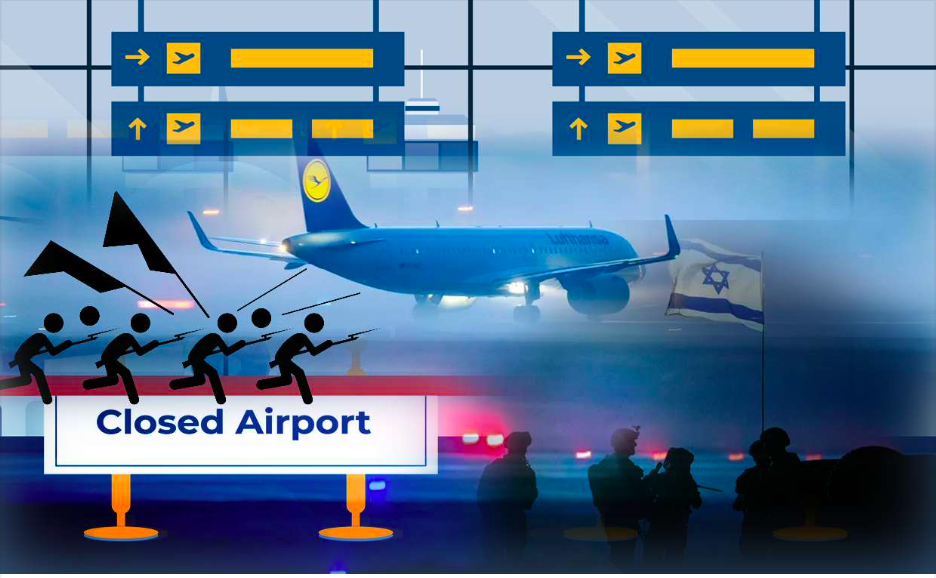
- According to Israeli newspaper Haaretz Israel is not only feeling isolated but is also experiencing a sense of being under siege, particularly in the aviation sector.
- Once an integral part of the global community, with flights arriving regularly and people moving freely, the situation has changed due to this sense of being under siege and the accompanying hardships it entails.
- The newspaper noted that domestic flights within Israel have become almost impossible, with many settlers now staying close to fortified rooms out of fear of potential strikes.
- The feeling of being under siege intensified last week, as foreign airlines began avoiding Tel Aviv.
- The situation worsened when Lufthansa, the second-largest airline in Europe in terms of passenger numbers and fleet size, stopped landing in occupied Palestine, signalling a collapse of the Israeli aviation sector.
- Ticket prices have soared, with Haaretz citing an example where a one-way ticket from London to Tel Aviv on El Al Airlines costs US$1,487.
- A round-trip ticket from Tel Aviv to London is priced at US$2,366, with the added challenge that economy-class seats are currently unavailable.
- The newspaper also pointed out that airline owners are among the few who are benefiting from the ongoing war and soaring tensions.
- El Al, a publicly traded company controlled by Eli Rozenberg, son of American billionaire Kenny Rozenberg, became the most profitable airline in the first quarter of this year, reporting a net profit of $80.5 million.
- Meanwhile, an Israeli expert on national security affairs, Colonel Kobi Marom said Israelis were living through a “nerve-racking” period in anticipation of the Iranian retaliation to Haniyeh’s assassination.
- He explained that this is part of Iran’s strategy of attrition against Israel.
- Walla also pointed out that hospitals in northern occupied Palestine are on high alert, fearing scenarios where thousands of rockets might be launched by Hezbollah and Iran, which might result in thousands of casualties.
- The outlet added that any escalation in the war would mean road closures, power outages, and shortages of food and fuel for generators.
- In preparation for the incoming response, the commander of the Israeli Air Force Major General Tomer Bar had issued a “special directive immediately prohibiting permanent service members from taking vacations outside Israel.”
- He also instructed that new, individual permission must be obtained for permanent service members to travel abroad, even for previously approved missions such as meetings and training.
- Also, a former Israeli military Ombudsman, Major General (Reservist) Itzhak Brik, warned that the ongoing war of attrition between Israel, Hamas, and Hezbollah not only fails to collapse the two groups but also exhausts and destroys Israel in several areas.
- In his article in the Israeli newspaper Maariv, Brik suggested that the collapse of Israel is unfolding from within and as a result of external pressures.
- He pointed out that Netanyahu had already brought Israel to the brink of this collapse even before the outbreak of a potential regional war.
- Nevertheless, he warned that if a multi-front regional war erupts, it would accelerate the timeline for Israel’s collapse.
- Touching on the situation of the Israeli military, the former Israeli official revealed that reservists, who are repeatedly called up for duty, are being severely drained because there are no replacements for them, due to the reduction of six brigades over the past 20 years.
- Economically, Brik emphasized that the war of attrition that has been going on for almost a year “has caused us [Israel] to lose the world.”
- He indicated that Israel has become isolated, with “even our best friends in European countries are turning their backs on us.”
- Brik also said that Israel’s isolation is reflected in economic boycotts, arms embargoes imposed by countries like the UK and France, and its exclusion from international ventures.
- Moreover, he highlighted Israel is facing a fiscal deficit exceeding 8%, with concerns within the Ministry of Finance that it could reach 9% in 2024, a figure far higher than the government’s target of 6.6%.
- Brik further noted that Israel’s credit rating is dropping weekly, which, in turn, makes loans to finance the war’s hefty costs more expensive.
- The former official also stressed that the prolonged war of attrition is damaging many of the drivers behind Israel’s economic growth, with high-tech professionals leaving the occupied lands.
- In the same vein, he noted that over 100,000 Israelis have been displaced from their settlements, while others are either unemployed or have seen their incomes drastically reduced, all of whom are now not contributing to taxes.
- Brik also said the International Court of Justice (ICJ) is inflicting irreversible damage on Israel, further deepening boycotts and hatred against it.
- Elsewhere, he acknowledged that Israel has no chance of survival if it continues to be pushed away from the community of what he called “enlightened nations”.
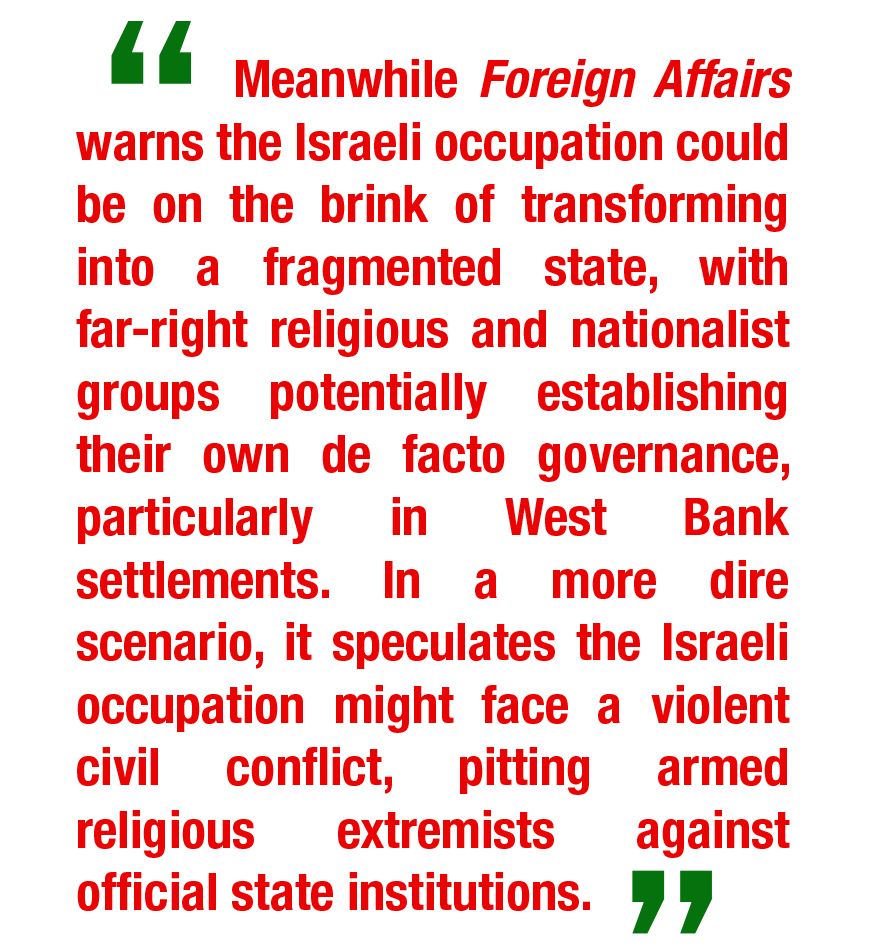
- Meanwhile Foreign Affairs warns the Israeli occupation could be on the brink of transforming into a fragmented state, with far-right religious and nationalist groups potentially establishing their own de facto governance, particularly in West Bank settlements.
- In a more dire scenario, it speculates the Israeli occupation might face a violent civil conflict, pitting armed religious extremists against official state institutions.

- Moreover, the presence of competing security forces and weakened parliamentary oversight is expected to undermine the Israeli security apparatus overall, potentially leading to the collapse of its governance structures.
- While a full-blown civil war has not yet materialized, Foreign Affairs cautions that the Israeli current path will likely result in prolonged instability and economic collapse, potentially leading to its failure.
- On the international stage, the magazine notes that the Israeli occupation is becoming increasingly isolated.
- Despite ongoing support from key allies like the US, it asserts that negative global public opinion, coupled with growing legal and diplomatic challenges, will further marginalize the Israeli occupation internationally.
- The role of its regional allies which included Jordan, Saudi Arabia and the United Arab Emirates in smashing drones and missiles launched from Iran became publicly known on April 13.
- At that time, Israel’s military chief praised the collaboration as opening “new opportunities for cooperation in the Middle East.”
- Even the naïve White House National Security Council spokesman John Kirby highlighted that it sent “a strong message about where Israel is in the region versus where Iran is in the region.”
- However, four months later, Israel finds itself more isolated in the region, a situation that military analysts warn could increase its vulnerability, that even with US support, there are growing concerns that Israeli air defence systems may struggle to repel a massive, coordinated attack.
- In April, the said Arab countries played down their involvement in repelling the Iranian attack, cautious of Tehran’s retaliation and reluctant to appear aligned with Israel amid widespread public anger over the Palestinian casualties in the Gaza Strip.
- Now, Arab states are also seeking to distance themselves publicly from any future interference.
- Jordan and Saudi Arabia have explicitly stated they do not want their airspace to become a battlefield, while Egypt has declared it will not participate in a military axis to repel an Iranian attack.

- In its impatience to see the Iranian retaliation quickly over and done with, Israel has publicly said that it will conduct a pre-emptive strike on Iran if it dilly dallies with the retaliation.
- This is a foolish move that will only delay the retaliation further as the Iranians will take their time to be ever alert in beefing up the defence of their homeland against this pre-emptive strike.
- It will just put Iran actively in both offensive and defensive modes – offensive in terms of continuing refining and calibrating a response that will make Israel regretful, but which will not lead to bleeding wounds from Iran, and defensive in terms of enhancing its air defence systems strong enough that it is impregnable to potential Israel’s pre-emptive or counter retaliation strikes.
- In this regard, a helping hand from Russia comes.
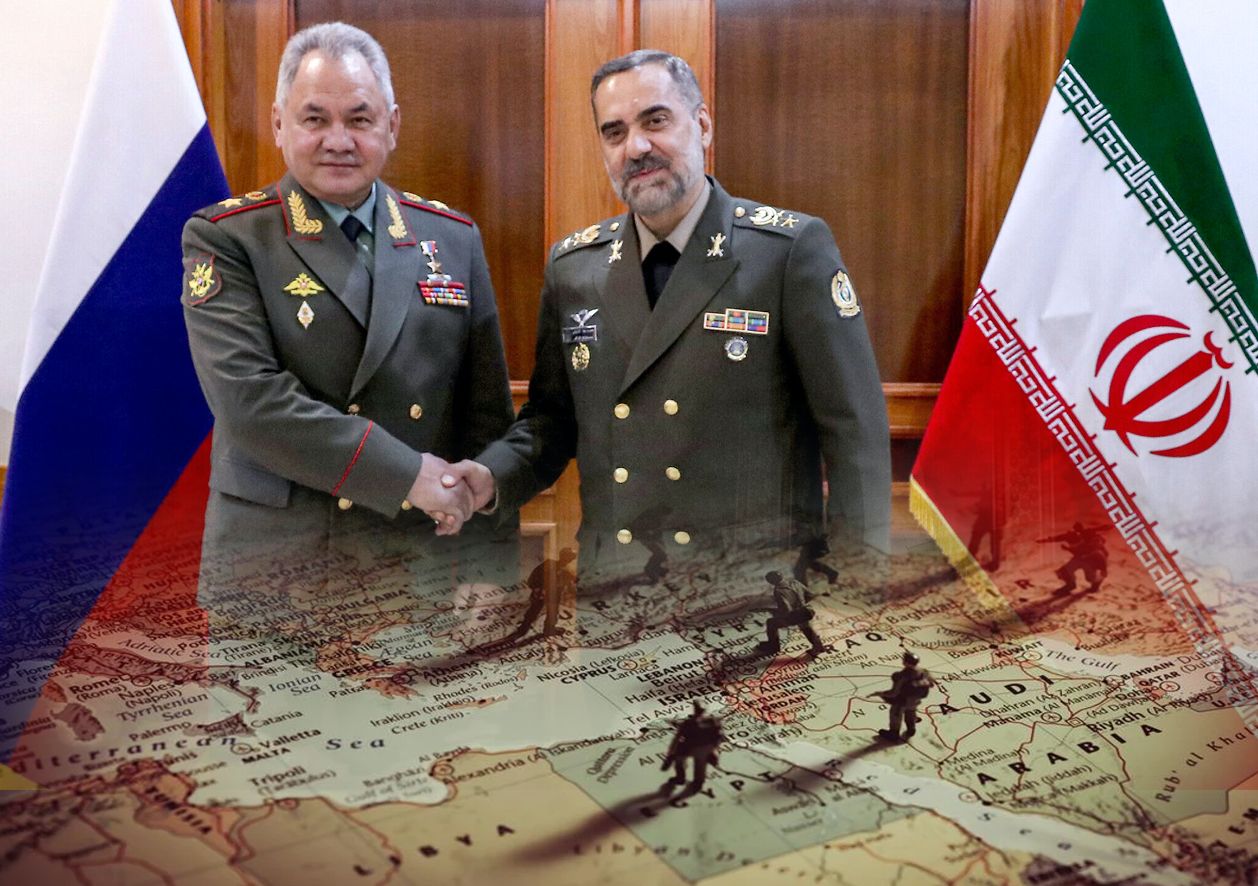
- On August 5, former Russian Defence Minister and currently Secretary of Russia’s National Security Council, Sergei Shoigu was in Tehran to confer with Rear Admiral Ali Akbar Ahmadian, a senior Islamic Revolutionary Guard Corps (IRGC) commander who serves as Secretary of Iran’s Supreme National Security Council.
- Shoigu also met with President Masoud Pezeshkian and the Iranian Chief of Staff of the Armed Forces of the Islamic Republic of Iran, Major General Mohammad Bagheri.
- Analysts noted that soon after Shoigu’s visit, a stream of Russian aircraft landed in Iran, reportedly carrying offensive and defensive military hardware, including the game-changing Murmansk-BN system, capable of jamming and scrambling all sorts of radio signals, GPS, communications, satellites, and electronic systems up to 5,000km away.
- According to veteran journalist Pepe Escobar, this is the ultimate nightmare for Israel and its Nato helpers. If deployed by Iran, the Murmansk-BN electronic warfare system can literally fry the whole Israeli grid, which is only 2,000km away, targeting military bases and also the electric grid.
- If Iran’s response intends to really go off the charts – teaching the occupation state an epic, unforgettable lesson – that might feature a combination of the Murmansk-BN system and new Iranian hypersonic missiles. And perhaps some extra Russian hypersonic surprises.
- But why would Russia do all these?
- Firstly, simply because Russia and Iran have a comprehensive strategic partnership including in the military field.
- Perhaps, Shoigu’s visit to Tehran to meet General Bagheri, after all, was to exactly round up the finer points of their comprehensive strategic partnership.
- Secondly, a few months back, President Vladimir Putin has already warned the US and the West that if they continue to arm Ukraine with weaponries and ammunitions in the Ukraine war, Russia will do the same in arming countries that are the enemies of the US and the West, in line with the adage that “the enemies of my enemy are my friends”.
- Putin’s recent visit to North Korea can be seen in this light, so too is the naval blockade of Israel by the Yemen Ansar Allah.
- This naval blockade which is aimed at pressuring for an end to the genocide in Gaza has led to ships linked to Israel, as well as US and UK military vessels, being targeted in the Red Sea, the Indian Ocean, the Mediterranean and the Arabian Sea.
- In the wake of the blockade, Ansar Allah has stated that it is working with Brics countries and has reached an understanding regarding its efforts, indicating that Russia and China are assisting Yemen in becoming a regional maritime power, aimed at undermining the supply lines of the US and its regional military and trade allies.
- Advanced capabilities, such as hypersonic missiles and air and undersea drones, have been used in these attacks, resulting in a significant reduction in ship traffic through the Suez Canal, which may suggest the involvement of great powers in arming Yemen.
- Bringing Brics into the picture, as mentioned by Ansar Allah, the relevant question to be asked is what would be the role of China in all these?
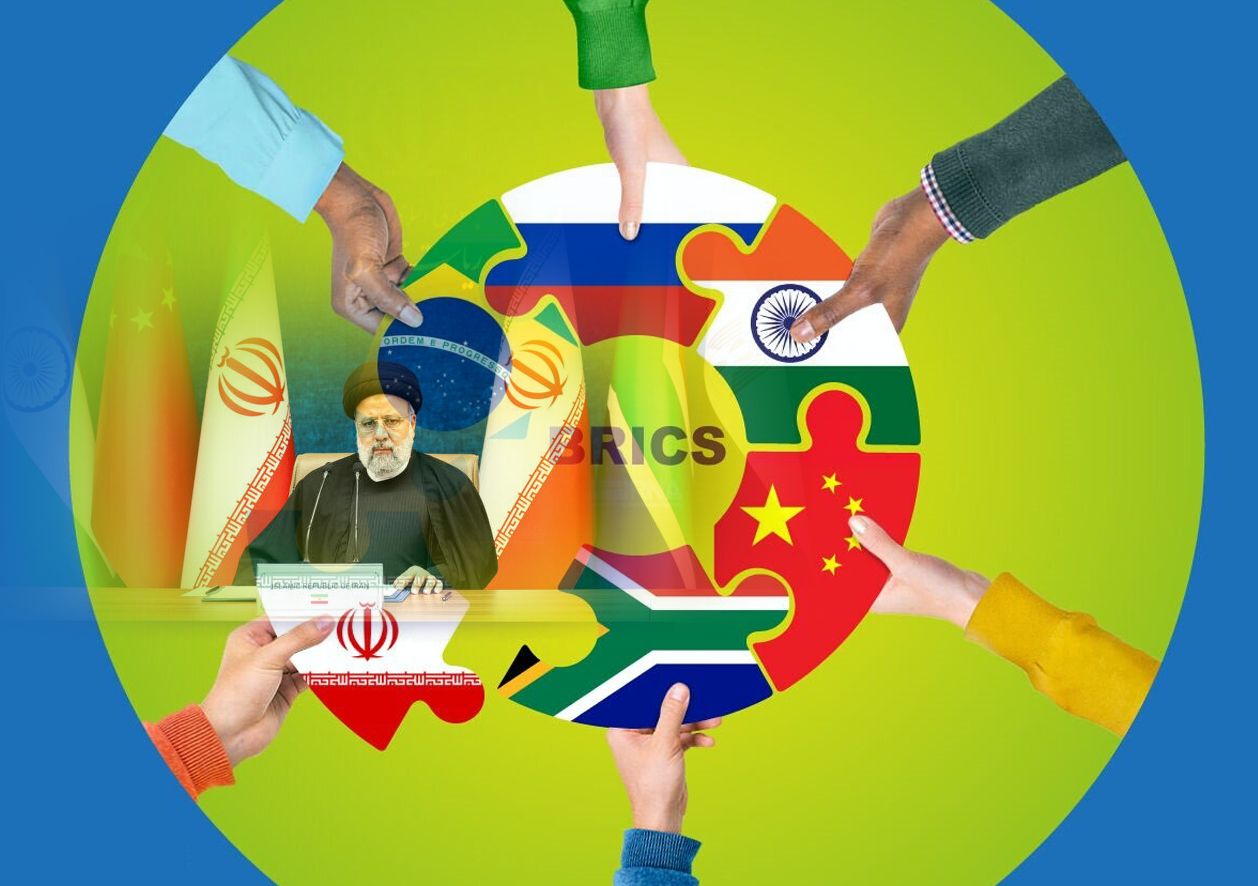
- We must remember that China and Iran have also forged strategic partnership. Moreover China, Iran and Russia had held joint military exercises since 2019.
- It is in this context and it’s quite telling that during his meeting with Shoigu, General Bagheri said: “We will welcome the tripartite cooperation of Iran, Russia, and China.”
- As Pepe Escobar puts it, the Israeli provocations, especially the assassination of Haniyeh, were a direct affront to three top Brics members: Iran, Russia, and China.
- So, the response to Israel implies a concerted articulation of the trio, deriving from its interlocked comprehensive strategic partnerships.
- Earlier on August 5, Chinese Foreign Minister Wang Yi took a crucial phone call from Iranian Acting Foreign Minister Ali Bagheri Kani, during which he adamantly supported all of Tehran’s efforts to ensure regional peace and stability.
- It also signals Chinese support for an Iranian reaction to Israel, especially considering that the assassination of Haniyeh was seen in Beijing as an unforgivable slap to its considerable diplomatic efforts only a few days after Haniyeh, alongside other Palestinian political representatives, signed the Beijing Declaration.
- This Declaration, among others, has called for the formation of a unity government among the various Palestinian factions to rule Gaza immediately after the war.
- As much as Russia and China are supporting Palestine and Iran on several levels, it’s inevitable that the focus of the US Forever Wars is now turned against all of them.
- Escalation is rampant across the board – in Ukraine, Israel, Syria, Iraq, and Yemen, plus colour revolutions from Bangladesh (successful) to Southeast Asia (aborted).
- Which brings us to the key drama in Tehran: how to carefully calibrate a response that will make Israel regretful, but not lead to bleeding wounds from Iran to Russia and China.
- The overarching clash is inevitable since Putin himself revealed it in stark terms when he said, “Any peace talks with Ukraine are impossible as long as it conducts strikes on civilian populations and threatens nuclear power plants.”
- The same applies to Israel in Gaza. “Peace talks” – or ceasefire negotiations – are impossible while Gaza and sovereign nations such as Syria, Iraq, and Yemen are being shelled at will.
- There’s only one way to deal with it: militarily, with smart force.
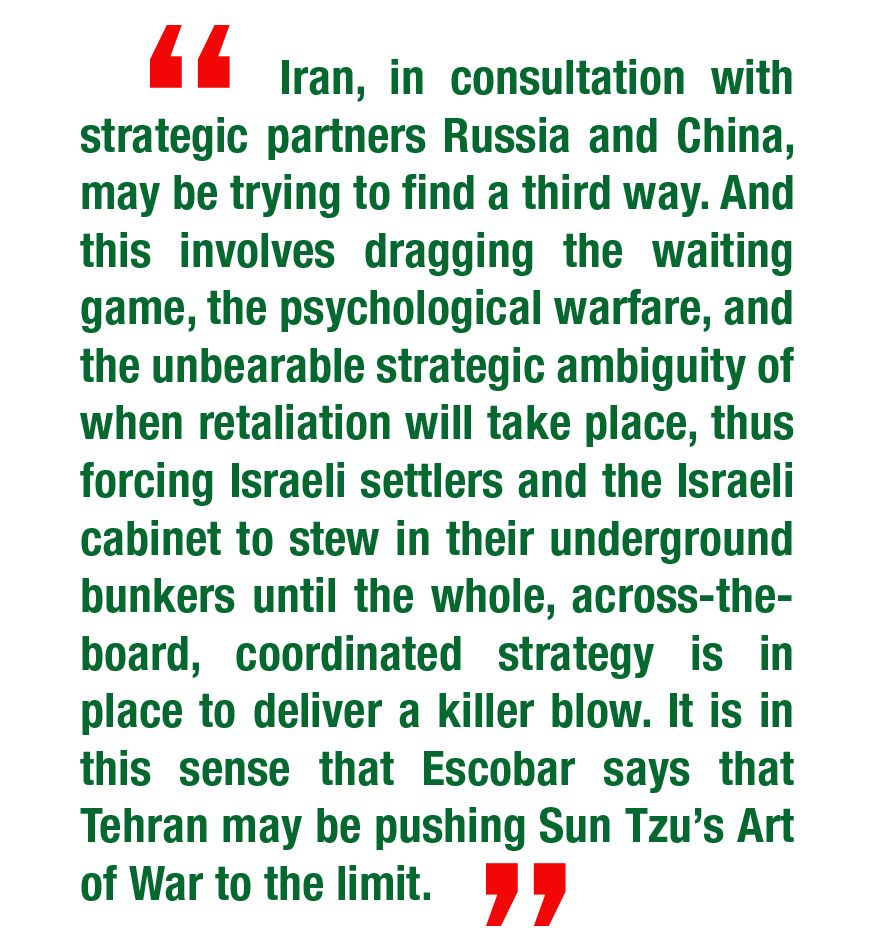
- Iran, in consultation with strategic partners Russia and China, may be trying to find a third way.
- And this involves dragging the waiting game, the psychological warfare, and the unbearable strategic ambiguity of when retaliation will take place, thus forcing Israeli settlers to stew in their underground bunkers until the whole, across-the-board, coordinated strategy is in place to deliver a killer blow.
- It is in this sense that Escobar says that Tehran may be pushing Sun Tzu’s Art of War to the limit.

- To summarise, Iran has three ways to respond to the transgression of its sovereignty by Israel in assassinating Haniyeh on its soil.
- The First Way is to forget about the retaliation in light of what the US Intelligence is asserting that Iran is having a second thought being fearful of the US military build-up in the Mediterranean and its warning of serious consequences for Iran if it goes ahead with the retaliation.
- But this is the most unlikely outcome as Iran has emphasised it will fight to the last man in order to preserve its sovereignty, and it has the military capacities and capabilities to respond to any attacks by the US.
- In fact when three Washington’s vassals in Europe – the UK, France and Germany – issued a statement begging Iran to not respond, Iranian diplomacy swiftly replied to the vassals, stressing its “recognized right” to defend national sovereignty and create deterrence against Israel, the real source of terrorism in West Asia. And crucially, emphasizing they “do not seek permission from anyone” to exercise it.
- The heart of the matter predictably escapes western logic: If Washington had forced a Gaza ceasefire last year, the risk of an apocalyptic war convulsing West Asia would have been avoided.
- Instead, the US approved a further US$20 billion weapons package to Tel Aviv, showing exactly how committed the Americans are to securing a permanent ceasefire.
- The Second Way is to teach the occupation state an epic, unforgettable lesson with a retaliation featuring a combination of the Murmansk-BN system and new Iranian hypersonic missiles, and perhaps some extra Russian hypersonic surprises.
- But this would involve a regional conflagration that in turn would lead to a third world war, although some analysts still think that this would be the answer without necessarily igniting into a regional war that would lead to WW3.
- The Third Way is mentioned by Escobar where Iran will push Sun Tzu’s Art of War to the limit by dragging out the waiting game, the psychological warfare, and the unbearable strategic ambiguity of when retaliation will take place, thus forcing Israeli settlers and the Israeli cabinet to stew in their underground bunkers until the whole, across-the-board, coordinated strategy is in place to deliver a killer blow.
- So it looks like Iran is in this retaliation game for the long haul. But how long is long in the long haul?
- Come to think of it, it would not really be very long if one takes into account the prophetic words of President Saddam Hussein of Iraq in 1983, as quoted in the book of another veteran journalist John Helmer, The Jackals’ Wedding: American Power, Arab Revolt:
- “The Israelis cannot withstand one year of fighting in a war.”
- No one has ever thought that Hamas is capable of conducting one of the best military operations in history on October 7, certainly not Mossad, not Shin Bet nor the CIA.
- And no one has ever thought that Hamas and Hezbollah could last for almost a year containing the Israeli aggression and genocide in Gaza, certainly not Mossad, not Shin Bet nor the CIA.
- So look out for the sequel to this article on or after October 7, 2024 for not only the Iranian retaliation but also who knows the end of the Israeli genocide in Gaza.
- Really it’s not a long wait. It’s just about one and a half months from today.


Read more on the Iranian Art of War in the long wait for the Iranian and the Axis of Resistance’s retaliation to the extra-judicial killings of Ismail Haniyeh and Commander Fuad Shukr by Israel, and the possible participation of Russia in it by providing both offensive and defensive military hardware to Iran:
Hezbollah Has $150 Bln in Israeli Infrastructure in Its Sights, May Have Flown UAV Over Bibi’s House
Hezbollah reveals massive underground base, reminds Israel retaliation imminent
Hezbollah unveils underground Imad 4 missile facility: Footage
Hezbollah’s increasing threat to Israeli security
UN Security Council members condemn Israel’s assassination of Hamas leader
OIC says Israel ‘fully responsible’ for Hamas chief Haniyeh’s killing
‘Complete Hypocrisy’: US Continues to Serve Israel as Fear of Middle East Conflict Grows
Sign of Anxiety? Pentagon Keeps Eye on ‘Deepening’ Russia-Iran Collaboration
Israel has achieved the maximum it can militarily in Gaza: NYT
Axis of Resistance definitely will respond to ‘Israel’, al-Houthi says
Central Israeli base lacks any ballistic protection, Army Radio warns
Dark future awaits ‘Israel’ after war on Gaza, Foreign Affairs says
Fyodor Lukyanov: Could Iran and Israel drift into a full-scale war?
Hochstein links preventing regional war to Gaza ceasefire
Iraqi resistance warns US of ‘unrestrained response’ if Iran attacked via Iraq’s airspace
Israel reaches ‘end of the line’ in Gaza, will ‘never defeat’ Hamas: US officials
Israeli economy in chaos in anticipation of Iran, Hezbollah responses
Israeli economy on the brink as it awaits retaliation from Resistance Axis
Israeli economy takes another hit after credit rating tanks
Palestinian factions steadfast in rejecting truce talks ‘that provide cover for Netanyahu’
Foreign Policy: ‘Israel’s’ existential fears exacerbate its aggression
Sanctions bolstered Iran military capabilities, general says
Military advisor says Iran showcased growing defense power in True Promise Operation
US braces for impending Middle East attacks amid rising tensions
US sees no way for Israel to destroy Hamas – NYT
US tells ‘Israel’ time to reach agreement to prevent regional war: CNN
‘Israel Itself is a War Crime’: US Fans the Flames in the Middle East as Israel Runs Rampant
Iran Says Retaliation on Israel Will ‘Guarantee Regional Stability’ as Media Talks Potential Targets
Iran to Show ‘Mature’ Response to Israel’s Killing of Hamas Chief – Pezeshkian’s Adviser
Israeli Defense Minister Told Pentagon Chief Iran Preparing Large-Scale Attack – Reports
ln Choosing Sides, US Says ‘Embassies Are Fair Game’
Iran says made breakthrough in defense capabilities
Israel’s geopolitical gamble necessitates a high-risk counter
Resistance Axis: a calculated, simultaneous strike on Israel
‘Tiny fraction of vast capabilities’: Israeli media on Hezbollah video
Austin, Gallant discuss Iranian retaliation, Gaza ceasefire
Fires rage in Safad area after large-scale rocket attack by Hezbollah
Global summit for Palestine set for late 2024: Dagestan Deputy Mufti
Hamas Does Not Believe That US Sincerely Wants to Stop Gaza War
Israel expects US and other allies to help bomb Iran
Israel Struggles to Hide Its Violence From World’s Eye
Missile cities ‘exist throughout Iran’: Iranian embassy in Lebanon
Netanyahu demands rival repay cost of US trip as divisions grow
Netanyahu offering ‘Israel’s’ collapse to enemies: Israeli media
Netanyahu refused to meet with UK FM over ICC clash
Northern front heats up, electricity supply lines damaged
Resistance ops nearly doubled ‘all over Israel’ in two years
Senior UK diplomat resigns over London’s ‘complicity’ in Gaza war crimes
Surge in doctors leaving ‘Israel’ amid staggering economic crisis
Under Biden, US budget deficit hits historic high of $6.6 trillion
Regards,
Jamari Mohtar
Editor, Let’s Talk!


P.S: Read our op-eds published by several news portals about the assassination of Hamas leader Ismail Haniyeh, the regional war in the Middle East, the end of the US Empire, the latest in the Ukraine war, the on-going Hamas-Israel war, unprecedented Hamas attack on Israel, Nagorno-Karabakh, Brics-11, the sanctions war imposed on Russia, the Black Sea Grain Initiative and China & Russia as peacemakers in the Middle East:
The oxymoron of assassinating a negotiator aza war has dire economic cost for Israel
Gaza war has dire economic cost for Israel
Regional war in the Middle East
2024 – Tectonic geopolitical change that will upend US empire
The year America failed to predict the unexpected
In 2023, the US fails to expect the unexpected
An ‘unexpected’ hardening of Russia’s stance
Hamas-Israel war spotlights Palestine sovereignty
Don’t underestimate the Muslim-Arab group working for a ceasefire via diplomacy
US, Israel may be on verge of defeat in war of attrition
The Plan For Israel To Supply Natural Gas To Europe
Israel’s plan to supply gas to Europe
The plan for Israel to supply natural gas to Europe
Possible reason why Israel attacks Gaza
The anatomy of a war of attrition
The world on the brink of a major war?
Diplomacy as a response to Israel-Gaza war
Regional superpower caught with pants down by ‘ragtag’ fighters
The crude sophistication of Hamas’ tactics
Blaming Russian ‘ineffective’ peacekeeping to start a war
Nagorno-Karabakh: War games on a chessboard turned real?
Implications of an expanded BRICS
Black Sea grain deal – another blow to the global economy?
Black Sea Grain Initiative hits a snag
The Global Whammy Of Rising Food Inflation
SURAT | Hebatnya pukulan kenaikan inflasi makanan sedunia
Russia has already won the sanctions war
China and Russia: Peacemakers in the Middle East with a difference

Recent posts
- Vol 4 No 50: Will Iran directly enter the regional war in the Middle East that has started on Dec 31? [PDF]
- Vol 4 No 51: The economy and US presidential election: Ticking time bomb for Israel’s defeat [PDF]
- Vol 4 No 52: Israel and its four fairy tales on Hamas [PDF]
- Vol 4 No 53: Unprecedented Iran’s slap on Israel’s face that has many firsts [PDF]
- Vol 4 No 54: The world in chaos [PDF]
- Vol 4 No 55: Panic and despondency before the storm [PDF]