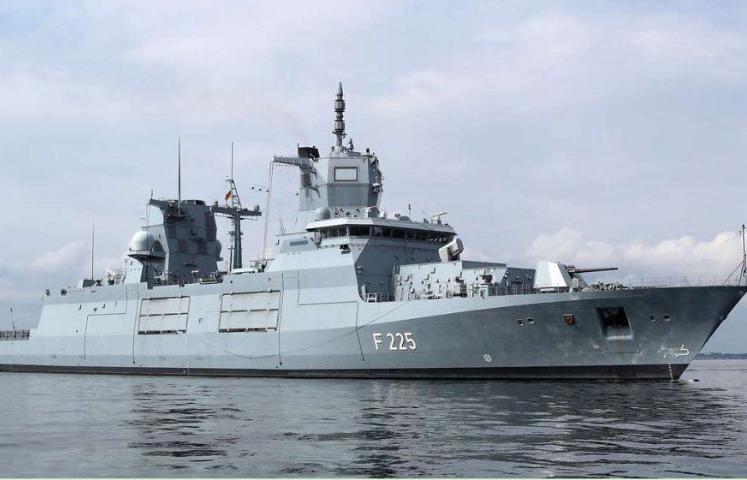
German Defence Minister Boris Pistorius ordered the German Navy’s Baden-Wurttemberg frigate and Frankfurt-am-Main auxiliary replenishment ship to take the long way home back to Germany after the end of their deployment in the Indo-Pacific.
Der Spiegel says Pistorius ordered the ships – which recently docked in Goa, India, to avoid the Houthi-controlled Red Sea, with the vessels instead expected to sail south-westward through the Indian Ocean, around South Africa through the Cape of Good Hope before heading north up the west coast of Africa.
The German Defence Ministry reportedly debated over whether a Red Sea route was justifiable, but “in the end, skepticism prevailed,” with “the decisive factor” being “that the security situation in the Red Sea had deteriorated significantly,” with German allies involved in a security mission in the strategic body of water reportedly making it clear to Berlin “that escort protection is currently not possible.”
The risk of a further escalation of the conflict between Iran and Israel also impacted Pistorius’s decision, Spiegel said, citing the Houthis’ allegiance to the Axis of Resistance, and the Israeli military’s habit of attacking Houthi positions after the militia’s missile and drone strikes targeting Israel and its allies.
The media outlet also cited recent warnings by Greek Rear Admiral Vasileios Gryparis, commander in charge of the European Union’s Operation Aspides Red Sea security mission, that the Houthis are “constantly adapting their tactics” and have “managed to extend the radius of their attacks into the Mediterranean and the Indian Ocean.” The coalition urgently needs more warships for its mission, Gryparis indicated.
Operation Aspides has been far less combat-intensive than the parallel US-UK-led Operation Prosperity Guardian, shooting down just a handful of Houthi aerial and naval drones using the sole destroyer, two frigates and lone joint support ship provided for the operation.
For comparison, Houthi operations against the US-led coalition has resulted in the destruction of nearly a dozen Reaper drones, and nearly landed direct hits against two US warships, including the US supercarrier USS Dwight D. Eisenhower, in combat operations over the past year. Unlike the US-UK mission, Operation Aspides has not included bombings of Houthi sites inside Yemen.
The German Navy’s decision comes amid growing fears among Western observers that the longer the Middle East conflict triggered by the Gaza war continues, the more entrenched the Houthis will become, with their multi-phase escalation accompanied by the creation and fielding of new long-range aerial drones, new missiles, and most recently, a new submersible kamikaze drone.
This week, Washington, DC-based security affairs think tank the Stimson Centre warned the longer the regional crisis continues, the greater the threat of the Houthis mining the approaches to the Red Sea, and turning the conflict into an Iran-Iraq War-style battle for key trade routes.
Meanwhile, the Wall Street Journal on Wednesday touted the militia’s transformation from a group of “ragtag rebels” into a “global threat” “snarling trade and increasing shipping costs,” with militia expert Michael Knights telling the outlet that “the Houthis have morphed from sandal-wearing fighters to rock stars” and “people who you want to be associated with right now.”