


- The Houthis Ansarallah from Yemen has made it very clear from the very beginning that their participation in the Axis of Resistance which includes Iran, the militias in Iraq and Syria, and Lebanon’s Hezbollah is aimed at forcing Israel to accept a permanent ceasefire in the Gaza war so as to prevent the genocide of the Palestinians that are being butchered by Israel.
- The massacres of Palestinian civilians by Israel are still continuing as the Gaza war reached past its 100 days on Jan 14.
- Moreover this aim of the Houthis and the Resistance is not something unilateral, but is in line with international resolutions passed by the UN General Assembly and its Security Council for an immediate permanent ceasefire in Gaza because the situation there has reached a humanitarian catastrophe.
- It is Israel that is intransigent in which it continues to kill Palestinian civilians where to date more than 25,000, the vast majority being children and women, have been killed with many more injured by its continued aerial bombing of Gaza.
- Not contented with just killing civilians, Israel has also prevented the entry of humanitarian assistance into Gaza because of its declared policy since the war started on October 7 to starve the Gazans by its refusal to let in food, water, medical supplies and fuel to enter Gaza.
- Israel has also made millions of Palestinians homeless and unable to seek treatment for their injuries because of the continued bombings of civilian infrastructures such as buildings, hospitals, schools, refugees camps, mosques and churches.
- Israeli siege of Gaza has broken a record of staying atop as the ‘most destructive’ in modern history.
- Since the beginning of the war, the Israeli blitz has “wreaked more destruction than the razing of Syria’s Aleppo between 2012 and 2016, Ukraine’s Mariupol or, proportionally, the Allied bombing of Germany in World War II,” as highlighted by AP on December 21.
- All these constitute war crimes and genocide which Israel has willingly committed in its pursuit to displace the Palestinians from Gaza in its quest to realise its goal of a Greater Israel.
- The Houthis having initially failed to stop Israel from continuing its genocide of the Palestinians via hurtling missiles at the southern cities of Israel which was defended by the Americans, came up with a brilliant idea of a naval blockade of Israel.
- The aim is to prevent global shipping from reaching Israel, thereby preventing Israel from meeting its basic needs that are imported via the sea, thus starving Israel much in the same way it has starved the Gazans by refusing to allow humanitarian assistance in the form of food, water, medical supplies and fuel from reaching Gaza.
- It is thus very clear what the Houthis has done in disrupting shipping to Israel is something just and noble in the context of a powerless global community to do anything to stop the genocide of the Palestinians.
- Moreover the Houthis have prevented global shipping from reaching Israel in the most moral way via preventing the loss of lives among the shipping crews that it has targeted.

- It first gives warning shots to ships that it deems are on their way to Israel. Only when these ships ignore these warning shots, the Houthis will then lob missiles at the ships.
- And it fires the missiles at the ships in such a way that there are no loss of lives, with at most fires breaking out on board the ships causing some injuries.
- So for the US to counter the Houthis by firing missiles at its navy on Dec 31 causing three boats of the Yemeni navy to be sunk and 10 of its naval troops to be killed really shows who the real terrorist is!
- Not contented with this terrorist act, the US and the UK have escalated the situation by bombing Yemen five times.
- The Houthis retaliated by immediately firing missiles on two US cargo ships so far, while it is still planning for a retaliation on US and British warships.
- “We reiterate that there is no ban on any ship except those linked to the criminal Zionist enemy or those heading to its ports in occupied Palestine,” Ansarallah spokesman Muhammad Abdel Salam said on Jan 16.
- However, a series of violent attacks launched in January against Yemen by Washington and London have placed US and British vessels in a precarious situation.
- Several US ships have already been attacked by Ansarallah and the Yemeni army in response to recent US and British airstrikes on Yemen, as well as in response to an earlier US attack in late December, which killed ten Yemeni naval officers.
- “Our operations will include American and British ships, and [US-UK] aggression will not change our position,” Ansarallah leader Abdel Malik al-Houthi said on 18 January.
- “The Yemeni Armed Forces reaffirm their commitment to taking all necessary military measures within the right to defend beloved Yemen and as a confirmation of the continued practical solidarity with the Palestinian people,” he concluded.
- The Houthis announced late on Jan 24 that intense clashes took place with several US warships escorting two commercial vessels attempting to transit the Bab al-Mandab Strait.
- “A clash occurred today (Jan 24) between a number of US destroyers and warships in the Gulf of Aden and Bab al-Mandab while they were protecting two US commercial ships,” the spokesman for the Yemeni armed forces, Brigadier General Yahya Saree, said in a video statement.
- “Despite attempts by the warships to intercept them, our ballistic missiles reached their targets successfully,” Saree’s statement added, noting that a US warship was “directly hit” and the commercial vessels “were forced to retreat.”
- According to the Yemeni official, the battle lasted for about two hours.
- Abdullah bin Amer, Deputy Head of the Moral Guidance Department at the Yemeni Ministry of Defence in Sanaa, said the US warships tried to counter the attack “in a confused and intense manner,” launching missiles that reportedly “fell into the sea [and] on the Yemeni mainland in empty areas”.
- This incident is confirmed in the early hours of Thursday (Jan 25), by Danish shipping giant Maersk that explosions nearby forced two ships operated by its US subsidiary – Maersk Line Limited (MLL) – to turn around as they attempted to transit the Bab al-Mandab Strait with a US navy escort.
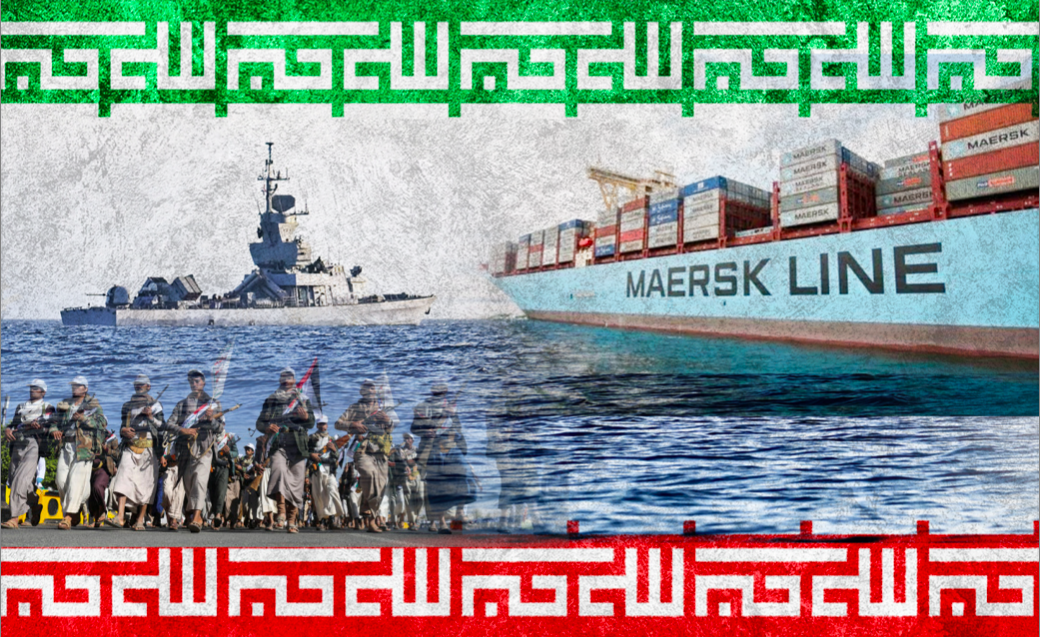
- “While en route, both ships reported seeing explosions close by, and the US Navy accompaniment also intercepted multiple projectiles,” Maersk said in a statement, adding it was suspending Red Sea transits by vessels of its US subsidiary.
- The two vessels were carrying “US military supplies”.
- In the latest incident on Jan 26, the Yemeni Armed Forces’ (YAF) Navy struck a British oil tanker, Marlin Luanda, in the Gulf of Aden, setting it ablaze, the spokesperson for the YAF, Brigadier General Yahya Saraee, said in a televised announcement.
- Meanwhile, the United Kingdom Maritime Trade Operations released an update on the ship’s situation at around midnight, confirming that the vessel is still on fire hours after it was targeted.
- The strike on Marlin Luanda marked the first time a UK ship had come under attack by the Yemeni forces.
- Saree, confirming that the attack was conducted using undisclosed naval missiles, referring to them merely as “appropriate”, reiterated the YAF’s operations will continue in the Red and Arabian seas against Israeli and Israel-bound ships until the Israeli war on Gaza is stopped and sufficient medicine and food are delivered to the besieged people in the Strip.
- This operation comes just one day after the YAF targeted and hit a US warship off the coast of Yemen.
- Let’s analyse why the US and the UK together with the support of their allies – Australia, Bahrain, Canada and the Netherlands – have decided to bomb Yemen since Jan 11.
- In response to more than 25 attacks on international shipping in the Red Sea by the Houthis, the US and British militaries with the support of their allies have attacked around 60 Houthi targets with more than 100 precision-guided missiles.
- Although the Houthis have been very clear about their objective in preventing global shipping from reaching Israel ala a naval blockade of Israel which is linked to the genocide in the Gaza war, the US, the UK and their allies with devious logic refuse to see this link.
- They instead view “ongoing Houthi attacks in the Red Sea are illegal, unacceptable, and profoundly destabilising” which “threaten lives, the global economy, and free flow of commerce in the region’s critical waterways”.
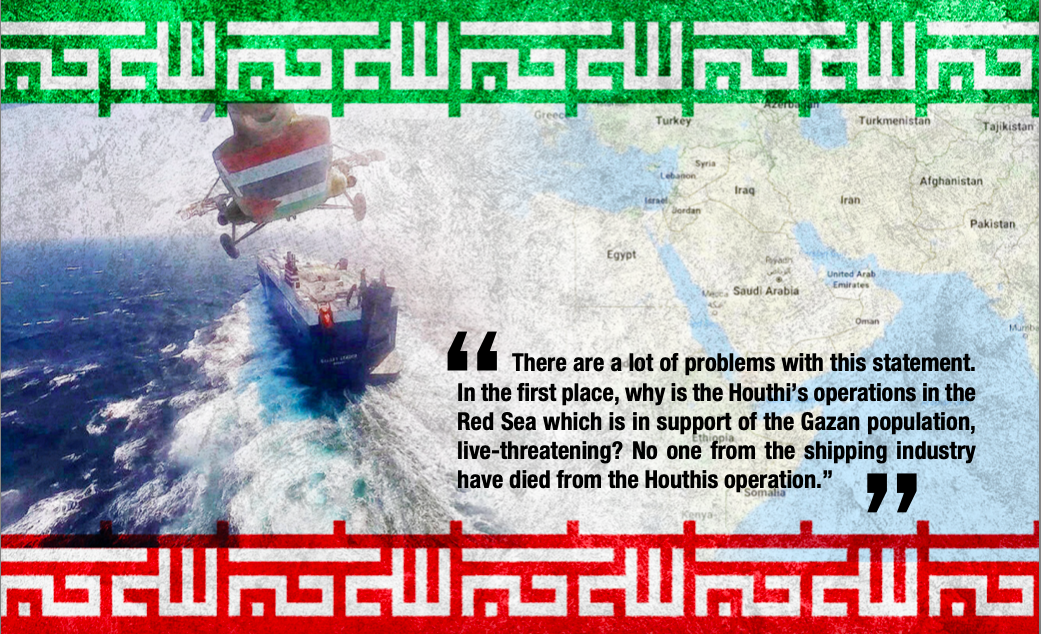
- There are a lot of problems with this statement. In the first place, why is the Houthi’s operations in the Red Sea which is in support of the Gazan population, live-threatening? No one from the shipping industry have died from the Houthis operation.
- And why should the Houthis operation be described as profoundly destabilising, threatening the global economy, and free flow of commerce in the region’s critical waterways?
- No doubt global shipping in the Red Sea accounts for 12% of worldwide trade, as an estimated US$1 trillion in goods annually pass through the Bab al-Mandab Strait, which is close to the Houthi-controlled western Yemen coast. And this route also accounts for approximately 40% of the world maritime trade.
- For the record, global shipping is also part of a larger maritime cluster in its position as buyer and customer.
- To get a better understanding of the relationship between the two, maritime trade is anything related to the ocean, sea, ships, navigation of ships from point A to point B, seafarers, ship owning and other related activities. In some cases, maritime trade can encompass pre- and post-shipping activities.
- While the shipping business per se is the act of carriage of cargo from point A to point B using the ships which falls under the maritime trade.
- The global shipping network is the worldwide network of maritime traffic in which, from a network science perspective, ports represent nodes and routes represent shipping lines.
- Transportation networks have a crucial role in today’s economy, more precisely, maritime traffic is one of the most important drivers of global trade.
- But when we talk about global shipping or for that matter world maritime trade, these don’t mean that the majority of global shipping and world maritime trade end up in Israeli ports.
- Israel is just only one of the many countries that global shipping and world maritime trade serve. There are many other countries making up the nodes and routes of global shipping and world maritime trade.
- And the Houthis have asserted they want global shipping and world maritime trade to flourish in the Red Sea and the Bab al-Mandab Strait.
- Due to what Israel has done to the Palestinians in Gaza, it’s just that the Houthis don’t want global shipping and world maritime trade to serve Israel.
- Israel alone logically forms a miniscule amount of the total value of global shipping and world maritime trade.
- So it doesn’t make sense for maritime insurance rates to rise exponentially or the need for shipping to go for the long route to the Horn of Africa in order to avoid the areas of the Red Sea and the Bab al-Mandab Strait, especially if their destination is not Israeli ports.
- This is just a knee-jerk reaction or rather herd instinct of the shipping lines to raise rates in the face of imaginary threat, which will only fatten the profits of the shipping lines and the shipowners.
- Shipping lines that do not go to Israel (the majority of course!) don’t even need to negotiate with the Houthis for safe passage in the Red Sea and the Bab al-Mandab Strait.
- All they need to do if they are stopped by the Houthis is to provide documentary evidence that their destination is not Israeli ports.
- Saudi and Chinese vessels, for instance, are undeterred by Yemen Red Sea ops, as they travel through the Red Sea and continue their passage through the strategic strait.
- Saudi Aramco, the world’s largest oil company, in January, increased crude shipments through the Red Sea toward Europe, according to vessel tracking data compiled by Bloomberg.
- “That is also giving us huge access and optionality,” Mohammed al-Qahtani, head of Aramco’s refining and oil trading and marketing businesses told Bloomberg on Jan 26. Qahtani said: “We are assessing that almost on a daily basis.”
- He said the cost of these shipments has increased, as few shipping companies are willing to travel the route, and insurance costs have risen. “But overall it’s very manageable.”
- Most Saudi crude is exported east to Asia, but the kingdom has been able to continue using the Red Sea route for western shipments due to its continued ties with the Yemeni government.

- As for China, its firms have stepped in to fill the void as western shipping companies have rerouted their ships, since China also enjoys good relations with Ansarallah and does not fear its ships being attacked in the Red Sea.
- Chinese firms have been serving ports such as Doraleh in Djibouti, Hodeidah in Yemen, and Jeddah in Saudi Arabia, which all saw major drops in port traffic following the attacks.
- Cichen Shen, the China expert at Lloyd’s List Intelligence told the Financial Times that the “easiest explanation” for the rush of Chinese operators into the region was that they seek to exploit their relative invulnerability to attack to win business.
- “You have commercial interest and you see this capacity gap and you see the demand,” Shen said of the lines’ motivation for moving ships to the region. “I think the commercial interest is probably the biggest reason.”
- On Jan 21, a member of the Yemeni Ansarallah resistance movement’s Supreme Political Council, Mohammad Ali al-Houthi, said dozens of commercial vessels not linked to Israel or bound for Israeli ports have been allowed to pass safely through the Red Sea.
- “You can visit the Tanker Trackers website, which specialises in tracking ships, to know that the simplest solution for ships to pass safely while crossing the Red Sea is to announce the phrase ‘We have no relation to Israel’ on their automated identification system. This solution has proved its effectiveness, as 64 ships safely passed through the sea by saying this phrase,” he added.
- Senior Ansarallah official Muhammad al-Bukhaiti said on Jan 19 Russian and Chinese vessels transiting the Red Sea will be safe, as long as they are not associated with Israel.
- These comments come days after it was reported that several ships, including vessels from China, Cameroon, and Singapore – among other states – had transmitted the message ‘We have no relation to Israel’ on their identification systems to avoid being attacked.
- Earlier this month, Saudi tanker Desert Rose wrote VL NO CONTACT ISRAEL on its identification system as it transited the Red Sea safely.

- The US, UK and their allies have maintained that their strikes on Houthi installations in Yemen are of a defensive nature and fully legal, but there are more than meet the eyes on this stance of theirs.
- The US as the leader of the pack was reported to have asserted that the strikes in Yemen were necessary, proportionate and consistent with international law.
- On January 12, at a UN Security Council Meeting on the Situation in the Red Sea, the US Representative to the UN, Linda Thomas-Greenfield in justifying the US, UK and their allies’ strikes on Yemen said:
- “These strikes were necessary, and they were proportionate, as you just heard from my UK colleague. They were consistent with international law, and in exercise of the US’ inherent right to self-defence, as reflected by Article 51 of the UN Charter. And they were taken only after non-military options proved inadequate to address the threat.”
- Scott Ritter, a former Marine Corps intelligence officer who was also a former UN chief weapons inspector, has debunked this misleading statement of the US ambassador to the UN.
- With this statement, Ritter claims that Thomas-Greenfield dishonestly delegates to the UN in defending the joint US-UK military strikes against targets affiliated with the Houthi militia undertaken on the night of January 12.
- The irony of this statement is that it was made before a body, the UN Security Council, which had not authorised any such action, thereby barring any claim to legality that could conceivably be made by the US.
- According to Ritter, the UN Charter specifies two conditions under international law in which military force can be used. One is in the conduct of legitimate self-defence as articulated in Article 51 of the Charter.
- The other is in accordance with the authority granted by the UN Security Council through a resolution passed under Chapter VII of the Charter.
- Both the US and UK invoked the notion of self-defence in their attacks on Yemen, thereby indirectly alluding to a possible cognisable action under Article 51 of the UN Charter.
- But US President Joe Biden demolished this argument of self-defence when he released a statement shortly after the strikes ended.
- That statement which is another justification for the US military attack on Houthi forces in Yemen said: “I ordered this military action in accordance with my responsibility to protect Americans at home and abroad.”
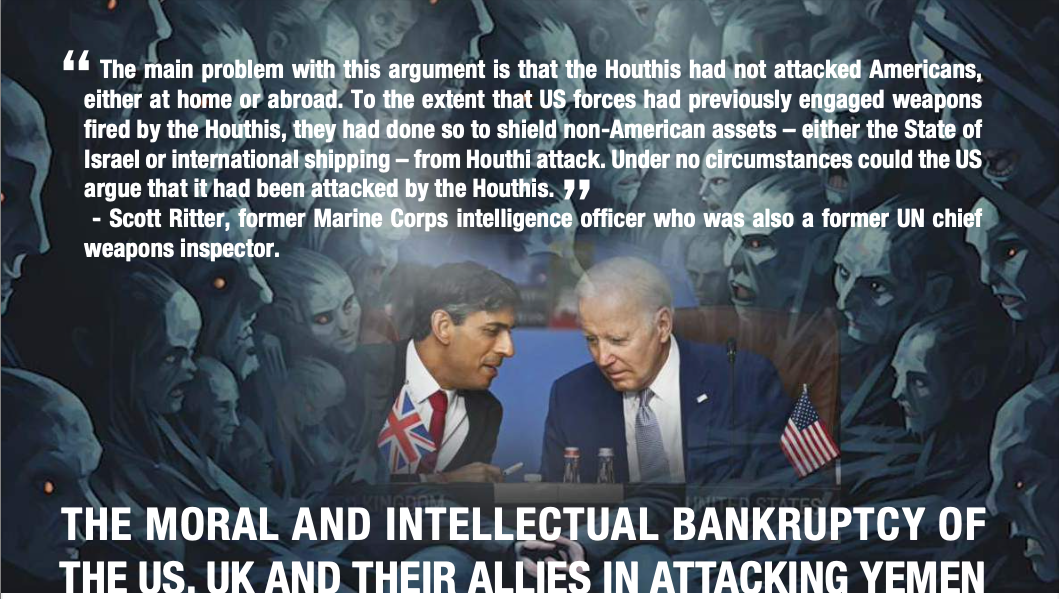
- The main problem with this argument is that the Houthis had not attacked Americans, either at home or abroad.
- To the extent that US forces had previously engaged weapons fired by the Houthis, they had done so to shield non-American assets – either the State of Israel or international shipping – from Houthi attack.
- Under no circumstances could the US argue that it had been attacked by the Houthis.
- The US attacks, Biden asserted, “were carried out to deter and weaken the Houthi ability to launch future attacks.”
- This suggests that the US was seeking to eliminate an imminent threat to commercial maritime operations in international shipping lanes.
- To comply with the requirements of international law regarding collective self-defence – the only possible argument for legitimacy since the US itself had not been attacked – the US would need to demonstrate that it was part of a collective of nation states that were either under attack by the Houthis or were threatened with imminent attack of a nature that precluded seeking Security Council intervention.

- In late December 2023, the US had, together with several other nations, gathered military forces in what was known as Operation Prosperity Guardian to deter Houthi attacks on maritime shipping that had been taking place since November 19, 2023.
- British foreign minister David Cameron cited the UN Security Council in his justification of the UK’s involvement in the attacks on Yemen, claiming that the Council had “made clear” that the “Houthi must halt attacks in the Red Sea”.
- While the Security Council had issued a resolution demanding that the Houthi cease their attacks on international shipping in the Red Sea, this resolution was NOT passed under Chapter VII, and therefore neither the US nor the UK had any authority under international law to carry out their attacks on Yemen.
- However, the US subsequently undermined any case it could possibly have made that its actions were consistent with international law, namely that they were an act of collective pre-emptive self-defence done in accordance with Article 51 of the UN Charter.
- US Central Command which is responsible for operations in the Middle East, issued a press release shortly after Washington launched a second attack against a Houthi radar installation that it claims was involved in targeting shipping in the Red Sea.
- The statement claimed the attack on the Houthi radar installation was a “follow-on action” of the strikes carried out on January 12, and had “no association with and are separate from Operation Prosperity Guardian, a defensive coalition of over 20 countries operating in the Red Sea, Bab al-Mandeb Strait, and the Gulf of Aden.
- By distancing itself from Operation Prosperity Guardian, the US has been stupid enough to fatally undermine any notion of pre-emptive collective self-defence under Article 51 of the UN Charter, thus highlighting the unilateral, and inherently illegal nature of its military attacks on Yemen.
- Such is the stupidity of the US that it is morally and intellectually bankrupt of coherent arguments to defend itself.
- Meanwhile analysts are saying that the US-led airstrikes against the Houthis have not been successful in halting the Yemen-based group from escalating attacks on ships.
- If anything,the situation has gotten worse. “Are they stopping the Houthis? No. Are they going to continue? Yes,” US President Joe Biden told reporters in a somewhat confused frame of mind.
- As long as the Israel-Hamas war rages, the Houthis insist they will maintain their campaign against shipping.
- Critics also say that anyone who followed the Houthis’ hardened resistance to years of Saudi military airstrikes should have known the US and UK attacks on the group would have little impact.
- Bloomberg’s Karl Maier highlighted that the return of the US military to the Middle East is encountering challenges, as the US-led airstrikes against Yemen have proven ineffective in curbing the group’s operations.
- This situation underscored the complexities and difficulties faced in addressing security issues in the region. It also emphasised the ongoing struggle to maintain stability in maritime activities amid heightened tensions in the Red Sea.
- The analysis accentuated the need for a comprehensive and strategic approach to contend with the evolving challenges posed by Ansarallah operations in the area.
- Maier aptly remarked: “The US military is back in the Middle East. It’s not going very well.”
- Meanwhile a Yemeni military official said the US-led coalition failed to monitor and locate the launch sites of the Yemeni Armed Forces’ anti-ship missiles launch site.
- Coalition satellites and American spy planes failed to locate the launch sites of missiles that targeted a US-owned Ocean Jazz cargo ship in the Gulf of Aden – the ship that transports US military equipment.
- The official also revealed that the US-led strikes were conducted in “targeted sites which previously were targeted tens of times.”
- Explaining that the targeted locations are “insignificant”, the military source said the sites house no weapons or military equipment, adding that there were no forces positioned there at the time of the aggression.
- The locations attacked by the US-led coalition had previously been subjected to repeated airstrikes by the Saudi-led coalition during previous years of the war on Yemen.
- He pointed out that between March 2015 and March 2020, al-Dailami Air Base had endured more than 200 airstrikes, which completely destroyed its facilities.
- Farea al-Muslimi, a Yemen specialist at Chatham House, stated that the strikes were mostly symbolic in nature, adding that the sites are “really only peanuts” in the military capabilities of Ansarallah, particularly their maritime weapons.
- “They are savvier, more prepared, and more equipped than anyone is really acknowledging.”
- Meanwhile, The Times reported that the threats from Ansarallah after the strikes against them took place only indicate that they are completely “undeterred from attacking ships in the Red Sea”.
- One former senior defence figure stated that he did not believe the group would take warnings seriously, and they would “even step up the attacks on the shipping.”
- In its statement, Defense Priorities, an American foreign policy think tank that advocates for more restrained US foreign policy said the strikes in Yemen are ineffective and invite escalation.
- “The strikes on the Houthis will not work. That is, they are very unlikely to stop Houthi attacks on shipping. The strikes’ probable failure will invite escalation to more violent means that may also fail. That is why striking the Houthis is a bad idea.
- “They will leave policymakers looking feckless and thus tempted to up the ante to more pointless war to solve a problem better left to diplomatic means,” said its policy director Benjamin H Friedman.
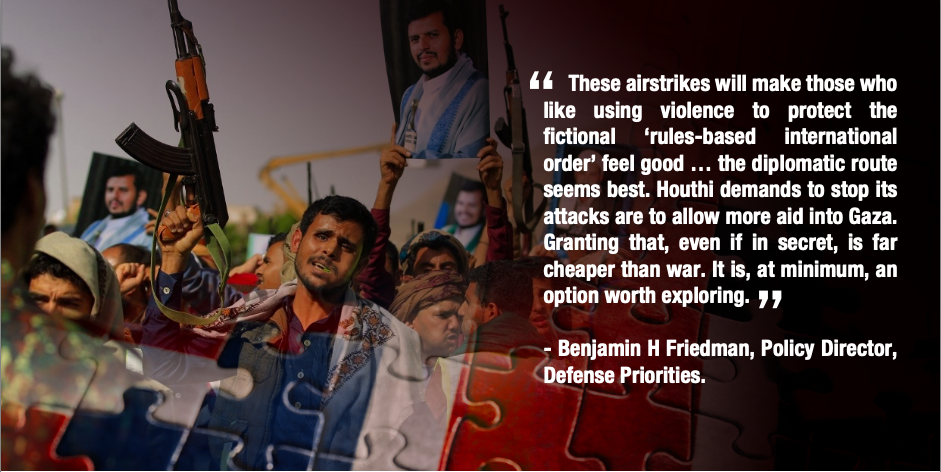
- Adding that these airstrikes “will make those who like using violence to protect the fictional ‘rules-based international order’ feel good”, Friedman also said it will only allow those who insist we ‘must do something more’ on behalf of global shipping to have a ‘something.’ But beyond the psychological health of elites, there is no payoff.
- “Tactically, the attacks on a dozen or so targets are far too limited to deprive the Houthis of their ability to use missiles and drones to target shipping off their coast.
- “Strategically, the punishment inflicted on the Houthis is essentially a pinprick, which will do little to deter attacks that Houthi leaders obviously think has a large political payoff in enhancing their domestic legitimacy,” he added.
- The fact that the Houthi attacks on shipping have not been a major economic issue as the consequence is a minor price increase, borne primarily by European and Chinese consumers suggests that the imperative to solve this problem need not be Washington’s.
- “But if it is, the diplomatic route seems best. Houthi demands to stop its attacks are to allow more aid into Gaza. Granting that, even if in secret, is far cheaper than war. It is, at minimum, an option worth exploring,” said Friedman.
- In the end the US has to adopt an embarrassing posture in appealing to its rival, China for help in asking it to convince Iran, another rival of the US, to persuade the Houthis to stop its attack on global shipping that serves Israel.
- In the words of a Russian political analyst, Timur Fomenko, the US creates crises around the world, then wants China to solve them. Washington likes to make others sort out its messes, but Beijing won’t play this game – and is thus branded a disruptive force.

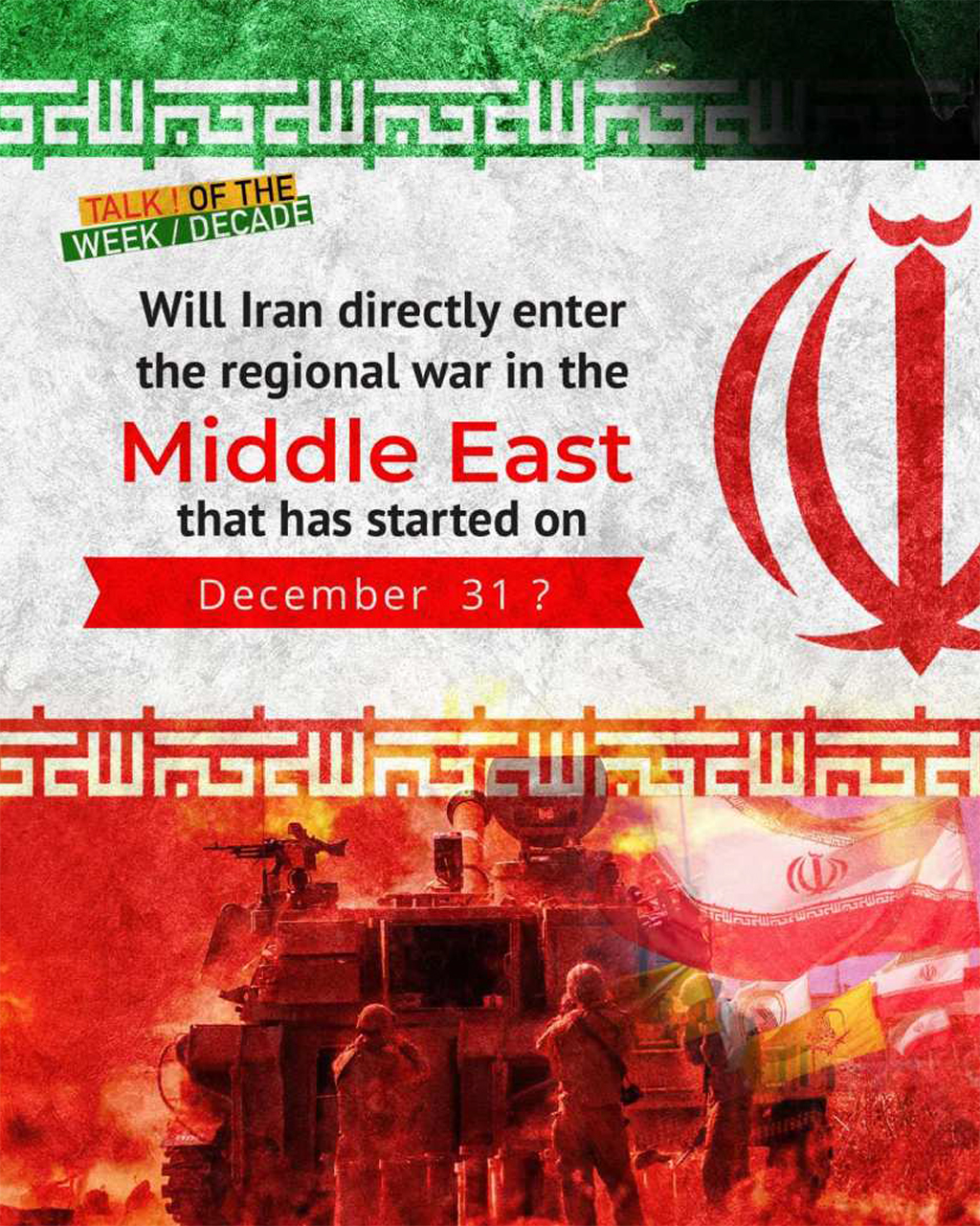
- With the latest news late yesterday evening (Jan 28) of an attack on a US base in northeast Jordan, near the Syria border by the Iraqi resistance forces which resulted for the first time in the death of three US soldiers, the relevant question to be asked is no longer will Iran directly enter the regional war in the Middle East that had begun on Dec 31, but rather will the Americans escalate further the regional war it has started by attacking Iran?
- The US Central Command (Centcom) announced on Sunday evening (Jan 28) that three US soldiers had been killed, while at least 25 have been injured in north-eastern Jordan near the Syrian border.
- “On Jan 28, three US service members were killed and 25 injured from a one-way attack UAS that impacted at a base in northeast Jordan, near the Syrian border,” Centcom said before adding that the identity of those killed while deployed will not be revealed for 24 hours.
- Later, citing a US official, Reuters reported the number of US soldiers injured in the drone attack at the al-Tanf Base in north east Jordan has risen to 34.
- President Joe Biden pinned the blame for the deadly attack on a US base in Jordan on “Iran-backed militant groups” while also saying that the US was still gathering the facts.
- “While we are still gathering the facts of this attack, we know it was carried out by radical Iran-backed militant groups operating in Syria and Iraq,” Biden said. He described the attack as “despicable and wholly unjust.”
- “We will carry on their commitment to fight terrorism. And have no doubt – we will hold all those responsible to account at a time and in a manner of our choosing,” the president’s statement read.
- The Wall Street Journal, citing a US official, reported that the attack targeted a small military outpost in Jordan, which is Tower 22 near the Syrian border.
- Citing a US military official, The Washington Post reported that the drone struck the living quarters at the base, causing injuries ranging from cuts, bruises, and brain injuries, some of which required medical evacuation.
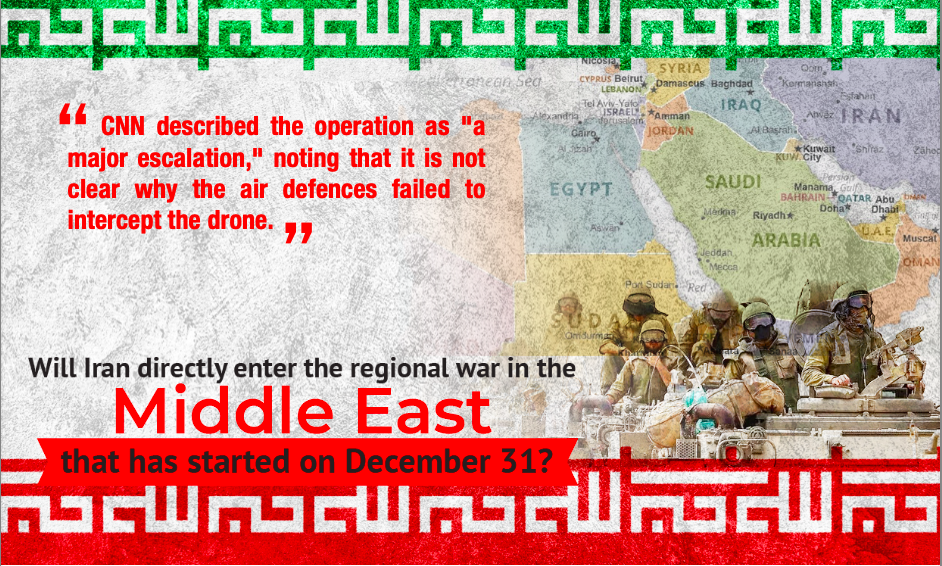
- On the other hand, CNN described the operation as “a major escalation,” noting that it is not clear why the air defences failed to intercept the drone, noting that as of Friday (Jan 26), there had been more than 158 attacks on US and US-led coalition forces in Iraq and Syria.
- The Centcom statement mentioned about “a one-way attack UAS”. But what is a UAS?
- A UAS or Unmanned Aircraft Systems includes not only the Unmanned Aerial Vehicle (UAV) or drone but also the person on the ground controlling the flight and the system in place that connects both of them.
- Basically, the UAV is a component of the UAS, since it refers to only the vehicle itself.
- While “drones” make most people think of “an unmanned aircraft” that can fly autonomously – that is, without a human in control, it can actually be used to describe a wide variety of vehicles.
- For example, there are seafaring or land based autonomously vehicles that also count under the given definition of drone.
- Of course, the most common usage of the term refers to an aircraft that can be remotely or autonomously guided. The only thing most experts can agree on with this term is that a drone doesn’t have a pilot inside.
- A UAV is able to fly remotely such as with a controller or tablet or autonomously. The two terms – UAV and drone – are often used interchangeably.
- However, many professionals in the industry believe UAVs need to have autonomous flight capabilities, whereas drones do not, which means all UAVs are drones but not vice versa.
- Coming back to the one-way attack UAS, sources say the UAV component of the UAS managed to bypass an advanced air defence system and penetrated the al-Tanf Base, targeting US soldiers.
- They also noted that this attack came one day after the attacks on the Conoco base north of Deir Ezzor, which resulted in the injury of three soldiers.
- Meanwhile the Islamic Resistance in Iraq on Jan 28 claimed responsibility for a series of drone attacks on five enemy positions in the region targeting the US forces in Syria and Iraq, as well as the Israeli occupation forces in occupied Palestine.
- Among these, three were aimed at US occupation bases situated in Syria, specifically targeting al-Shadadi, al-Rukban, and al-Tanf.
- The fourth strike was directed at a base near Erbil Airport in the Iraqi Kurdistan region while the fifth operation was executed on the Zevelun naval facility in occupied Palestine.
- The nature and extent of the damage caused by these drone strikes remain undisclosed.
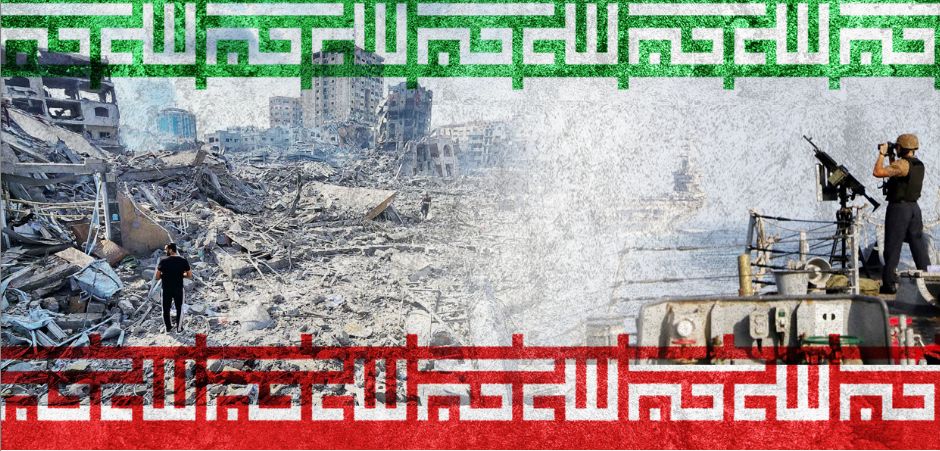
- With the exception of Israel, all parties to the regional war in the Middle East unleashed by the US on Dec 31 do not want an escalation of the Gaza war into a regional war.
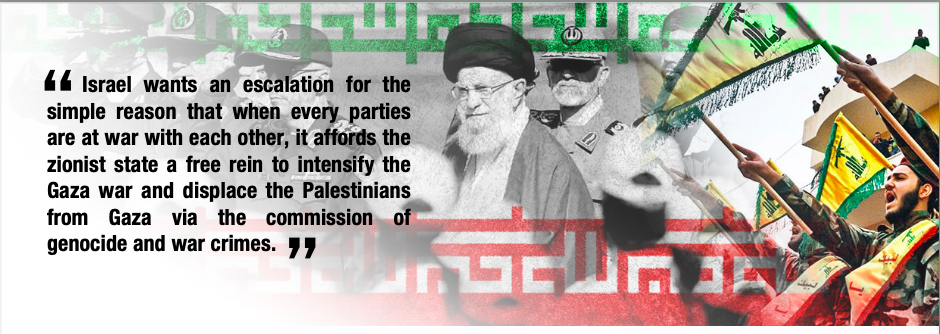
- Israel wants an escalation for the simple reason that when every parties are at war with each other, it affords Israel a free rein to intensify the Gaza war and displace the Palestinians from Gaza via the commission of genocide and war crimes.
- The US doesn’t want an escalation because its hands will be fully occupied and tied up with so many “forever wars” which include its proxy war with Russia in Ukraine which it is losing.
- Other forever wars it is now involved in are its meddling in Taiwan to contain China which the US views as its real rival both economically and militarily, and its proxy war with North Korea in the Korean peninsula where it plays a BIG part in instigating South Korea and Japan to antagonise the North Koreans.
- Moreover escalation would also mean an attrition war and the US is not equipped to face an attrition war because it is already facing dire shortages in ammunitions and weaponries brought about by both the Ukraine war and its weapons and ammunitions support for Israel in the Gaza war.
- Similarly Iran and its partners in the Axis of Resistance also do not want an escalation because their focus and priority is on the economic development of their respective countries.
- But make no mistake about what analysts say the reticence of Iran and the Axis of Resistance to escalate, as from the very beginning they have said their escalation is conditional on whether Israel will escalate the Gaza war into a bloodbath of the Palestinians.
- They will escalate in tune with the escalation in the Gaza war by Israel, and hence the rationale for the attacks by the Houthis on global shipping that serve Israel and the attacks on northern Israel by Hezbollah.
- But what about the attacks on American bases in Iraq and Syria?
- This happens because the Axis of Resistance sees the US as complicit in the genocide of the Palestinians by its supply of the weapons and ammunitions of mass destruction to Israel for the latter to finish the job of ethnic cleansing of the Palestinians.
- Moreover the act of setting military bases without the consent of the Syrian government constitutes an illegal occupation of Syria that has enabled the US to steal Syrian oils and grains, while in the case of Iraq, the US has turned a deaf ear to the request of the Iraqi government to dismantle the bases and for US soldiers to leave the country.
- The US is also guilty of escalation when they sank three boats of the Yemeni navy resulting in the loss of lives of 10 Yemeni naval officers on Dec 31, marking the start of the regional war we are witnessing today, followed by the US’ targeting of an Iraqi resistance leader by a drone attack in Baghdad which resulted in his death, and finally the recent bombings of Yemen.
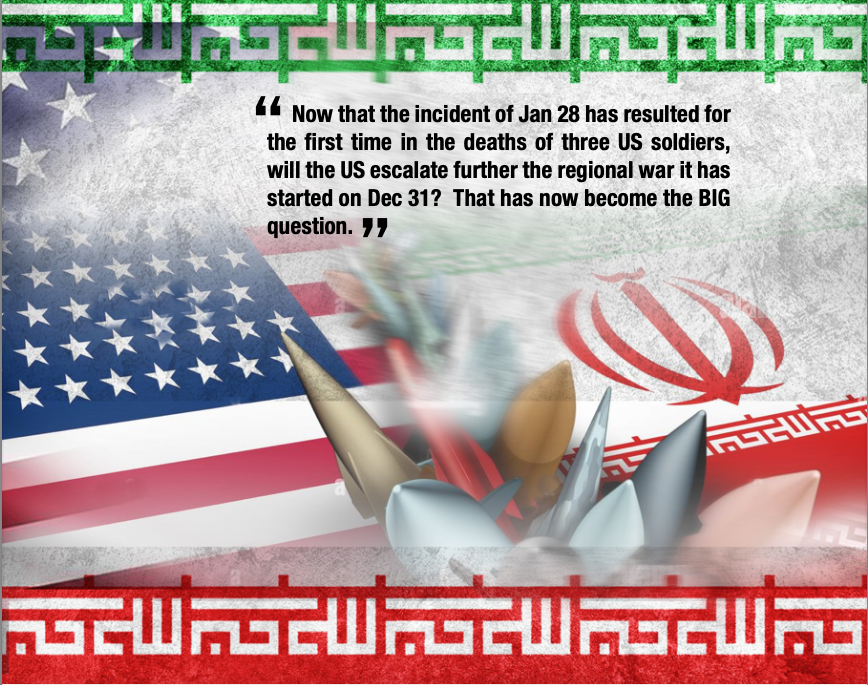
- Now that the incident of Jan 28 has resulted for the first time in the deaths of three US soldiers, will the US escalate further the regional war it has started on Dec 31?
- That has now become the BIG question.
Read more on the war of the high seas which has precipitated a regional war in the Middle East, the bombings of Yemen by the US, UK and their allies and the first deaths of US soldiers in the regional war:
Israeli siege of Gaza atop ‘most destructive’ in modern history
Israel-Gaza war spillover risk: Mapping recent strikes in Middle East
STRIKES IN YEMEN ARE INEFFECTIVE AND INVITE ESCALATION
IRAN, ISRAEL, AND WAR IN THE MIDDLE EAST
The U.S. Has No Endgame in Yemen
US launches new strikes on Yemen’s Houthis as conflict escalates
How Houthi attacks can impact global shipping across the Red Sea
How Yemen’s ‘asabiyya’ is reshaping geopolitics
Saudi, Chinese vessels undeterred by Yemen Red Sea ops
Is an all-out war in the Middle East inevitable?
Scott Ritter: How the US misleads the world about its involvement in Yemen
Lawmakers warn that Biden must seek authorization before further strikes on Yemen’s Houthi rebels
Crew extinguishes fire on oil tanker hit by Houthi missile off Yemen coast
Pentagon contradicts White House about US troop presence in Yemen
American Base Near Syria-Jordan Border Attacked Amidst Rejection of US Role in Area
Sources to Al Mayadeen: Drones bypassed US air defense systems
Iran denies links to Jordan drone strike that killed 3 US troops
RUSSIAN FOREIGN MINISTRY TIES RED SEA BLOCKADE TO GAZA BLOCKADE, BACKS HOUTHIS IN MOSCOW MEETING
The US creates crises around the world, then wants China to solve them
Saudi, Egyptian foreign ministers call for ceasefire in Gaza
How Zionism Indoctrinated the West
Israel Has Bought a Mass Online Influence System to Counter Antisemitism, Hamas Atrocity Denial
Paradigm Shift: The failure of the American Empire’s Propaganda Machine
Yeh Man, the U.S. Has an Addiction to War and Empire
US airstrikes are ‘acts of aggression’: Iraqi army spokesperson
US forces must leave, one way or another: Iraqi MP
US plans to end Syria occupation as regional tensions heat up: FP
MY PODCAST ON THE IMPENDING WAR WITH IRAN
WHAT WOULD ISRAEL DO IF THE SHOE WERE ON THE OTHER FOOT?
Resistance justified: Unmasking deceptive neutrality
DPRK, China bolster cooperation amid tensions on Peninsula
DPRK fired several cruise missiles from East Coast: Reports
US ‘concerned’ over possible Korean conflict – NYT
Iran ‘a legitimate target’ – Israel
Lebanon wants Russia involved in forging Middle East peace
Is war coming to the Korean peninsula?
Regards,
Jamari Mohtar
Editor, Let’s Talk!

P.S: Read our op-eds published by several news portals about the regional war in the Middle East, the end of the US Empire, the latest in the Ukraine war, the on-going Hamas-Israel war, unprecedented Hamas attack on Israel, Nagorno-Karabakh, Brics-11, the sanctions war imposed on Russia, the Black Sea Grain Initiative and China & Russia as peacemakers in the Middle East:
Regional war in the Middle East
2024 – Tectonic geopolitical change that will upend US empire
The year America failed to predict the unexpected
In 2023, the US fails to expect the unexpected
An ‘unexpected’ hardening of Russia’s stance
Hamas-Israel war spotlights Palestine sovereignty
Don’t underestimate the Muslim-Arab group working for a ceasefire via diplomacy
US, Israel may be on verge of defeat in war of attrition
The Plan For Israel To Supply Natural Gas To Europe
Israel’s plan to supply gas to Europe
The plan for Israel to supply natural gas to Europe
Possible reason why Israel attacks Gaza
The anatomy of a war of attrition
The world on the brink of a major war?
Diplomacy as a response to Israel-Gaza war
Regional superpower caught with pants down by ‘ragtag’ fighters
The crude sophistication of Hamas’ tactics
Blaming Russian ‘ineffective’ peacekeeping to start a war
Nagorno-Karabakh: War games on a chessboard turned real?
Implications of an expanded BRICS
Black Sea grain deal – another blow to the global economy?
Black Sea Grain Initiative hits a snag
The Global Whammy Of Rising Food Inflation
SURAT | Hebatnya pukulan kenaikan inflasi makanan sedunia
Russia has already won the sanctions war
China and Russia: Peacemakers in the Middle East with a difference
Recent posts
- Vol 3 No 44: The world on the brink of a major war? [PDF]
- Vol 3 No 45: The US and Israel may just be defeated in a war of attrition [PDF]
- Vol 3 No 46: Various endgame scenarios for the Hamas-Israel war [PDF]
- Vol 3 No 47: 2023 In Review (Part 1): The failure to expect the unexpected [PDF]
- Vol 3 No 48: 2023 in Review (Part 2): The year global public opinion shifted in favour of the Palestinians [PDF]
- Vol 4 No 49:2024 – Tectonic geopolitical change that will upend US Empire [PDF]