

- The Palestinian struggle for a sovereign state has once again gained prominence as a result of the Hamas-Israel war.
- The likelihood of peace in the Middle East anytime soon has also been dashed by the October 7 strike by Hamas and Israel’s response.
- The possibility of a larger regional war is all too real as significant pro-Palestinian protests break out in response to the Israeli offensive and atrocities in killing many Palestinian civilians, majority of whom are children and women.
- Some say the Hamas’ attack on Israel on Oct 7 was in part motivated by the Palestinians’ sense of desperation that the Abraham Accords, named for the patriarch of the three Abrahamic religions, would soon see Saudi Arabia normalising relations with Israel, thus putting the question of a Palestinian statehood on the back burner.
- Moreover some Muslims view any rapprochement between Saudi Arabia and Israel as an indication of the capitulation of another of their holy cities – Mecca and Medina – to political Zionism.
- The Abraham Accords was facilitated by the US under then-President Donald Trump in September 2020 between Israel, the United Arab Emirates (UAE) and Bahrain which resulted in the full diplomatic relations between the parties, and acknowledged Israel’s statehood.
- Following this, two more Arab countries – Morocco and Sudan – signed normalisation agreements, raising the possibility that more Arab nations may recognise Israel.
- US President Joe Biden carried over and enhanced President Trump’s Middle East strategy by attempting to mend fences between Israel and Saudi Arabia, two countries which had previously been bitter enemies.
- These policy shifts meant abandoning their long-standing stance on Palestine and were in line with US strategy in the Middle East, the result of which were the Palestinian people’s aspirations and expectations were replaced with indignation, hatred, and despair during this process.
- The outpouring of their rage is now all too visible for everyone to see because they were disregarded.
- As pointed out by former US Marine officer who was also a former UN weapons inspector, Scott Ritter, the Abraham Accords was predicated on the notion that Israel would work toward some form of Palestinian statehood, but that’s only lip service.
- “The reality of the Abraham Accords is just they (Israel) steal more lands from the Palestinians. It is unacceptable but because Israel was making good with the Arab world that they normalise relations with UAE, Bahrain and others and they are on the verge of normalising relation with Saudi Arabia which would have been a very big deal, and so the issue of Palestinians state was pushed to the side.

- “Now because of what Hamas has done, it is the only issue on the table today. Say what you want about Hamas action (but) it has in the long term, from a strategic perspective, done more to push forward the issue of Palestinian state than anything else,” he added.
- The fundamental tenet of the Abraham Accords – that there could be Middle East peace without resolving the Palestinian issue – has proven to be a fallacy.
- Normalisation between Israel and the Arab world is now in ruins. Even the Arab nations who aimed to restore relations with Israel were compelled to retract and censure Tel Aviv.
- Today, most of the Global South’s nations support the Palestinians. In a resolution approved by the UN General Assembly, the majority of them voted in favour of a “humanitarian pause” in the combat in Gaza, with 14 voting against and 44 abstaining.
- Over six nations – including South Africa – have removed all of their ambassadors from Israel in opposition to the country’s brutality in the Gaza Strip.
- Remarkably, despite denouncing Russia’s invasion of Ukraine, the Global South supports Russia and China against the US-led pro-Israeli geopolitical construct.
- This might present grave long-term risks to US strategic objectives, which include containing China’s influence in the Middle East, Africa, and the Asia-Pacific region.
- Even if the exact boundaries are still unclear, there is no denying that the Gaza War is changing geopolitics in a big way.
- Perhaps the Arab nations’ decision to forge diplomatic relations with Israel was also motivated by concern over Iran’s increasing assertiveness.
- But this notion of Iran’s assertiveness could only be correct before the rapprochement between Iran and Saudi Arabia that was brokered by China took place in March.
- Relations between the two countries become better since then with the resumption of diplomatic relations in May.
- And both countries independently sought for a Brics membership in August which was accepted at the Brics Summit in South Africa. Their effective membership of Brics will begin in January 2024.
- Hence the argument of Iran’s assertiveness in the region breaks into pieces when we consider that Saudi Arabia and Iran are now together in Brics.
- So it does not make sense to say that the Oct 7 Hamas attack on Israel was due to the concern over Saudi Arabia normalising relations with Israel or Iran’s increasing assertiveness.
- Even before the Oct 7 attack, the Saudis have made it clear that normalising relations with Israel is predicated on the establishment of an independent Palestinian state.
- A high ranking Saudi official was reported to have visited the Palestinian Authority in the West Bank to give that assurance to the Palestinians way before the current Hamas-Israel war had begun.

- What really happened was since the last conflict with Israel in 2021, before even the talk of normalising relations between Saudi Arabia and Israel begins, Hamas has been planning for an attrition war against Israel in order to free the Palestinians from the Israeli occupation.
- It meticulously study all the Israeli wars against Arab armies since 1948 and comes out with some strategies, the main thrust of which is aimed at destroying Israel’s capacity to survive in its present state in a long war.
- This means attacking the invincibility of the Israel Defence Forces (IDF) and their so-called Iron Dome defence, which began with the cross-border offensive on October 7, and continues with daily drone and artillery attacks on targets inside Israel, as well as resistance to IDF incursions in Gaza.
- According to Scott Ritter, what Hamas did is the greatest military raid of this century. It was a military raid if you read what makes up a military raid, and how it was executed, he said.
- “It has tragic consequences for hundreds of people. I’m not denying that and I’m not trying to brush that under the carpet. War is hell but this was war, a military raid against a military enemy. Israel was defeated. They got slapped around and then suckered into a trap and they are in Gaza right now, stuck in Gaza.
- “They haven’t made any meaningful advances in the last couple of days. Their troops are taking increasingly heavy casualties. They have to stop the sale of their own Merkava-3 tanks because they now have to take these tanks and turn them into reserve armoured battalion to make up for the tanks losses they suffered in Gaza and in the north against Hezbollah.”
- Ritter went on to say that the Israeli government was on virtual collapse prior to this war because of the judicial changes made by prime minister Benjamin Netanyahu and his far-right allies in the Knesset to prevent him and his wife from going to jail for massive corruption charges.
- And now the Israeli government is literally not only on life support, but it is also losing support in the US.
- “Even the President of US who is thoroughly pro-Israel is compelled to say that how Israel is executing this campaign is wrong. They always say Israel has the right to defend itself but how it defends itself matters. What Israel has done is carried out extraordinary war crime right in our face, they don’t even deny it.
- “They bombed refugee camps in violation of international law. They subject the Palestinian people to collective punishment in violation of international law. They attacked hospitals in violation of international law. What do they have left?
- “They just see total collapse in the PR front, so they carried out a very crude campaign. And it is so crude that they are making up as they go along,” said the former UN weapons inspector.
- Ritter is referring to the PR lies that Israel has given to attack the Al-Shifa Hospital on the assumption that it was a major base of the Hamas resistance group by showing the caches of weapons in the hospital after it has captured the hospital.
- Just imagine in a war, how can a military be so proud of capturing a hospital? Never has this happened in the annals of military history.

- Does this mean Ritter, unlike the US and many European countries, is saying that Hamas is not a terrorist organisation?
- “I’m not going to accept the idea that Hamas on Oct 7 was a terrorist organisation. They were carrying out a military assault and they carried out with far more precision and far less collateral damage than what Israel is doing.
- “If you want to call Hamas a terrorist organisation, then every single Israeli pilot that flies over Gaza today and indiscriminately drops bombs that kill Palestinian civilians (more than 13,000 at the latest count, including over five thousand of them children), then they are the terrorists.
- “And if they are terrorists, everybody who wears the green (uniform) of the IDF (Israel Defence Force) is a terrorist. And every Israeli politician is a terrorist and I think it’s more accurate to call Israel a terrorist entity in this case than it is to say Hamas.”
- So, what does Ritter think of the so-called atrocities that Hamas has allegedly committed on Oct 7 that are being repeated ad nauseum by Israel and many world leaders?
- “We can go back to the beginning of World War 1 and look at atrocity propaganda. When the German marched into Belgium, it literally was accused of raping babies out of the womb and beheading children, of doing raping and all these stuffs.
- “Hamas has been accused of the same thing. Every day (we hear) the standard thing that they beheaded children, they raped women. There is no evidence they did any of them. It hasn’t been presented.
- “From a policy standpoint in fact there is overwhelming evidence that Hamas being a very fundamentalist Islamic organisation they actually treat women with respect. Imagine that all the women hostages have said they treated us with respect, they give us better, good care.
- “Unless this is propaganda, and until you find evidence that counters that, that’s the one we had documented not by Hamas saying it but by the hostages themselves, by the people that was held by Hamas.”
- According to Ritter, “at some point in time the Netanyahu government is going to be held to account for what happened on Oct 7” and that we will find that “the Israeli people will not forgive them”.
- “Everybody who died when they become documented … had an autopsy done on them. There is a file in there that say bullets wound here, entry point here, exit point here, mechanism of death is this, time of death is this, place of death is that.
- “And when an investigator comes in and starts overlaying all that out, it is going to become clear what the survivors have been saying that it was the IDF that killed everybody.
- “The IDF came in and just haphazardly without any discipline and in a total panic fired indiscriminately, killing the hostages and Hamas alike. Then this atrocity propaganda (of Hamas atrocities) is flushed down the toilet. And suddenly we talked about criminality. It’s criminality that took place,” he added.

- So what this in essence means is the same-old, same-old endgame of a ceasefire that will see some years of quiet before it turned into a disquiet followed by a new outbreak of the same-old, same-old conflict will not happen.
- Unlike the present conflict, Israel has never declared past conflicts with Hamas as a war. In a war, if you agree to a ceasefire with your enemy which you deem as inferior to you militarily, then that is as good as admitting your defeat.
- This is the reason why Israel would never entertain any demand for a ceasefire, whether a humanitarian one or otherwise.
- Moreover during the Oct 7 battle, Israel was already humiliated with a staggering loss of its soldiers when about half of those killed by Hamas were Israeli soldiers.
- In other words, Israel is actually fighting a war of defeat in the sense that it was defeated by Hamas on Oct 7 and the raging war now is to avenge that defeat.
- And we can see the insanity of Israel war of defeat by targeting civilians instead of Hamas combatants as a sign of its raging frustrations that it has lost quite a significant number of its troops and tanks to Hamas.
- Each time Hamas scored a big win in its ambushes of the Israeli occupier, the IDF strikes back with killing more Palestinian civilians as its response.
- A professional and civilised army will counter this loss of troops with more brilliant tactics and strategies on the battlefield on how to kill more enemy combatants, but because crude revenge is the only thing in the minds of the Israeli war planners, they are experiencing a dearth of ideas on this and thus, resorted to the best thing they have known all this while and are very good at – killing mercilessly all Palestinian civilians.
- Every bombs dropped by the IDF on Gaza did not kill Hamas fighters, they only killed innocent Palestinian civilians, vast majority of whom are children, women and the elderly.
- On Hamas side, it has agreed to only a humanitarian ceasefire in order to facilitate the exchange of hostages for the thousands of Palestinians in Israel’s jails for no other crimes than being a Palestinian.
- But because Israel has responded on this ceasefire proposal of Hamas with more bombings of civilian buildings and infrastructures causing in some cases the deaths of some of these hostages, Hamas is no longer interested in this humanitarian truce.
- And so the war rages on.
- However in the latest development on Nov 22, the Israeli government has voted to accept a deal for a temporary ceasefire in Gaza, during which some hostages held by Hamas will be exchanged for Palestinian prisoners in Israeli jails.
- The decision was backed by all branches of the Israeli security services – the IDF, Shin Bet, and Mossad.
- Hamas is expected to release around 50 Israeli women and children once a pause in the fighting commences. The first hostages was released on Nov 24, comprising 13 Israeli women and children who emerged free from Gaza.
- Most were in their 70s or 80s, and the youngest was a 2-year-old. Also released were 10 people from Thailand and one from the Philippines.
- On the same day, Israel freed 39 Palestinians from prison in the first stage of a swap under a four-day cease-fire that offered a small glimmer of relief to both sides.
- Israel has published a list of the Palestinian prisoners set for release, and the public will have 24 hours to file their objections. The list will reportedly include some 150 Palestinians, mostly women and children, none of whom are accused of killing Israelis.
- The temporary ceasefire could be extended further if Hamas frees more women and children, or “by a day for each group of 10 more Israeli hostages,” according to the Times of Israel.

- Ahead of the cabinet’s vote, Netanyahu told the ministers that accepting the deal was “a difficult decision but it’s a right decision,” and vowed that Israel would continue its war with Hamas after the temporary truce.
- “We are at war, and we will continue the war,” Netanyahu said. “We will continue until we achieve all our goals.”
- Why this deal was described by Netanyahu as a difficult decision boggles the mind because none of the 150 Palestinians women and children prisoners were accused of killing Israelis.
- They were jailed by Israel for committing no crimes whatsoever which highlight the human rights abuses of Israel in putting to jail innocent Palestinian women and children in their occupation of Gaza and the West Bank.
- By right all these innocent Palestinian women and children should not be part of this hostage deal and should be freed by Israel long time ago.
- Thus one can see that if the Hamas assault on Israel by taking hostages had not occurred on Oct 7, these innocent Palestinian women and children would have rotted in Israeli jails until the day they die.
- This also means that Hamas does not intend to kill any hostages. They were captured as a means of exchange for the thousands of Palestinian prisoners in Israeli jails.
- Most of these Palestinian prisoners had been taken last year into “administrative detention,” without charges or trial and based on secret evidence.
- Israel often holds detainees for months without charges. Most of those who are tried are put before military courts that almost never acquit defendants and often don’t follow due process, human rights groups say.
- According to the Palestinian Prisoners’ Club, an advocacy group, Israel is currently holding 7,200 Palestinians, including about 2,000 arrested since the start of the war.
- Hamas fighters took around 240 hostages to Gaza during their October 7 assault on Israel, and have since released only four of these captives before the current exchange deal of hostages and prisoners took place.
- The welfare of the hostages has been a major concern for the Israeli public, who fear that the captives may be harmed during IDF’s ongoing air and ground operation in the enclave.
- Meanwhile it was not a smooth-sailing affair for Israel to agree to this deal as a far-right minister warns against ‘disaster’ of a hostage deal, and slams the ‘idiocy’ of the Israeli war cabinet.
- National Security Minister Itamar Ben Gvir who heads the far-right Otzma Yehudit party, said: “I am disturbed because we are once again being divided and once again we are not being told the truth. And once again, we are being pushed to the side.”
- Referring to a 2011 deal which saw the release of 1,027 security prisoners in exchange for Gilad Shalit, who was captured by Hamas in 2006 while serving in the IDF, Ben Gvir also said: “You remember that we released Gilad Shalit, we let out [Yahya] Sinwar and his friends and brought this trouble upon ourselves.”
- Among those released in that 2011 deal were prominent Hamas members Husam Badran, who now serves as a spokesperson of the group in Qatar, and Yahya Sinwar who leads Hamas inside the Gaza Strip.
- Sinwar is thought to be a key mastermind of the October 7 onslaught in southern Israel in which at least 1,200 people were killed and some 240 were kidnapped.
- Ben Gvir is not that stupid not to know that the present deal involves only women and children, and so his argument looks very dim-witted.
- He is actually talking about future deals which involve the exchange of Palestinian adult male prisoners with IDF soldiers that Hamas has captured.
- Since this kind of future deal would represent a defeat for Israel (how can you take another defeat in a war of defeat?), and Netanyahu himself has said that the war will continue after the present hostage deal is completed, there’s no way the same-old, same-old ceasefire as in previous conflicts will take place as an endgame scenario.
- And so the war rages on.


- Say what you want on Arab unity but in the present Hamas-Israel war, the unity of the Arab countries is relatively the most solid compared to previous Arab-Israel conflicts.
- On the onset of the outbreak of war, Egyptian President Abdel Fattah el-Sisi is staunchly consistent with his stance that Egypt would not allow Palestinians in Gaza from passing into the Rafah crossing because he does not want to see an Israeli victory with its Greater Israel (Eretz Yisrael) project by depopulating Gaza of the Palestinians.
- The Egyptians seem to have access to the secret intelligence report of Israel before it was leaked to the Israeli media about its proposal to deport en masse the Palestinians to the Sinai desert.
- In past conflicts, the Egyptian would sometime joined in, in eliminating the Palestinians at the Rafah crossing because of its dislike of the Muslim Brotherhood organisation which is behind the establishment of Hamas.
- There were no such incidents this time around as at all levels of the Egyptian government and its people a strong and solid support for their Palestinian brothers to have their own independent state were espoused.
- In fact Egypt allows its Rafah crossing to be the starting point for all humanitarian assistances from all over the world to enter the war-torn Gaza.
- It put pressure on President Joe Biden to use US leverage on Israel to force Israel to accept the delivery of food, water, medical supplies and fuel to enter Gaza for humanitarian assistance.
- Even then the cruelty of the IDF is seen when there were pictures of crates of water in containers being destroyed as a result of Israeli bombing of some Red Cross / Crescent trucks delivering water to Gaza.
- And then when Hamas political bureau made an appeal to Egypt to let the seriously injured Palestinians including premature babies to enter the Rafah crossing for treatment in Egypt, the latter acceded to the request promptly because of the dire and tragic state of all hospitals in Gaza due to Israel’s bombings of hospitals there.
- During the early days of the war it was reported that Egypt after having agreed to let foreign citizens stuck in Gaza to escape to safety in Egypt via the Rafah crossing suddenly not only changed its mind, but bombed the refugees including foreign citizens that were about to reach the crossing.
- Egypt later clarified that it was Israel planes that bombed the refugees causing it to close the Rafah crossing again.
- It was only after Egypt had pressured the US to pressure Israel not to bomb the Rafah crossing that the way is opened for foreign citizens stranded in Gaza and the seriously injured Palestinians to enter Egypt via the Rafah crossing.
- Jordan is more aggressive in supporting its Palestinian brothers by giving an ultimatum that any attempt by Israel to depopulate Gaza of Palestinians is a declaration of war.

- It not only recalled its Ambassador to Israel to return home but also told the Israeli Ambassador who had fled home to Israel in fear of his life due to the massive pro-Palestine protest in Amman not to return to Jordan until the latter has solved the issue of a Palestinian statehood.
- Jordan and UAE led the efforts of the Arab group in the UN working together with Russia, China and Brazil to urge the UN Security Council (UNSC) to adopt a resolution for a humanitarian ceasefire in the Gaza war.
- Although these efforts initially failed due to US veto, the Arab group didn’t give up and instead pushed for the same resolution in the UN General Assembly which voted overwhelmingly for the resolution.
- Despite initial failure in the UNSC, the Arab group persisted in its efforts to push for the same resolution in the UNSC which finally adopted it without a US veto when the words “humanitarian pause” in the resolution were changed to “humanitarian pauses” demanded by the US.
- With its twisted logic that a humanitarian pause means a long and permanent ceasefire that would allow Hamas to regroup and rebuild its military arsenals, the US is happy with frequent humanitarian pauses (plural) of four hours a day which can be extended to more hours to bring in a trickle of food, water and medical supplies to Gaza, forgetting the fact that without a permanent ceasefire more Palestinian civilians will be slaughtered by Israel using US-made bombs.
- From Day One of these efforts by the Arab group in the UN which was supported by the Muslim countries and the Global South, along with support from the Brics nations, there was for the first time in 75 years a sea-change in global public opinion which began to condemn the Israel onslaught on Palestinian civilians as a war of genocide.
- Even some EU countries like France, Italy and Spain have questioned the disproportionate response of Israel in the Gaza war and noted the flagrant violation of international laws by Israel in its execution of the war.
- Massive pro-Palestine protests where hundreds of thousands of people participated take place every week all over the world especially in the US, Canada, many European cities, Japan and South Korea, among others.
- In these massive protests, participants from all walks of life chant Free Palestine!, Stop the Genocide!, Stop the Killing of Palestinian Children and Babies!, and demand Israel’s political and military leaders to be arrested and put on trial for war crimes.
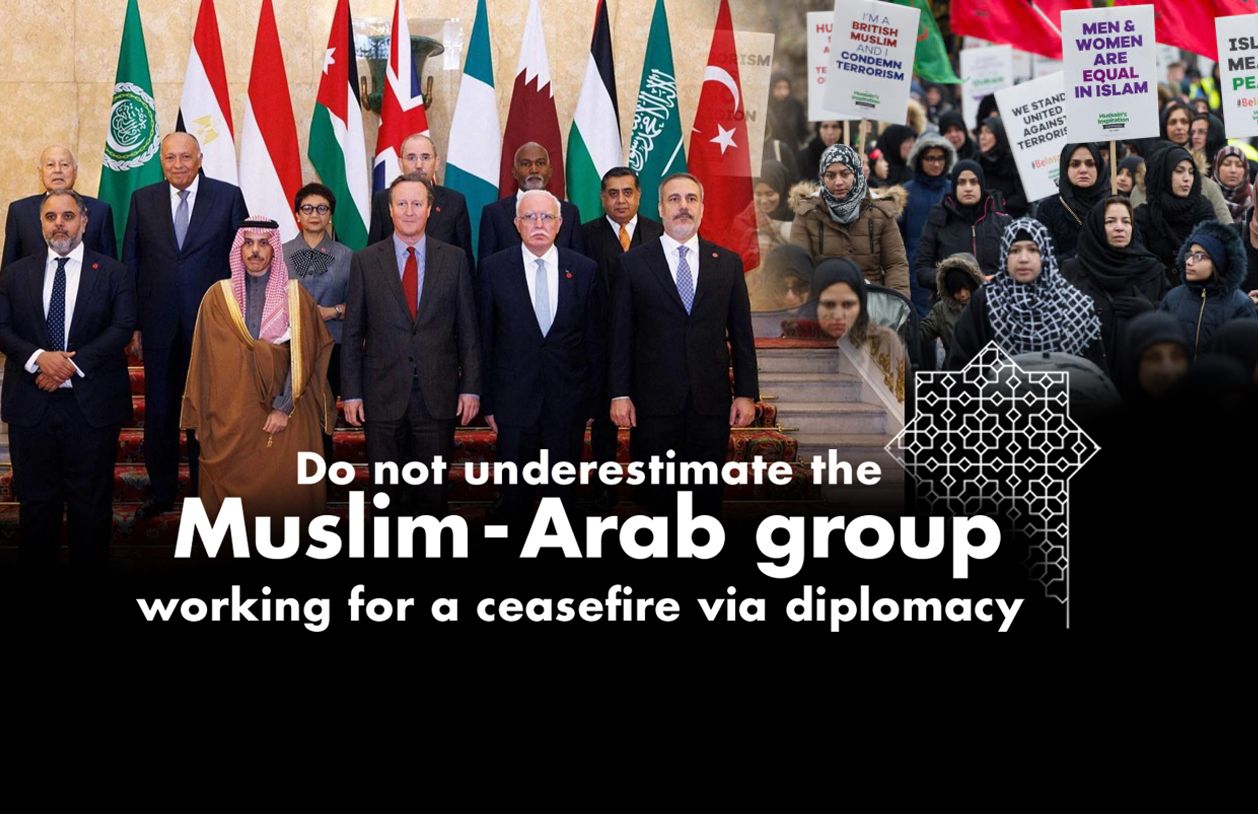
- Meanwhile, Saudi Arabia leads the way in holding a unified joint session of the Arab League and the Organisation of Islamic Cooperation (OIC) to discuss the Arab-Muslim world’s response to Israel’s atrocities in killing tens of thousands Palestinian civilians which they see as genocide and a blatant violation of international laws.
- That joint extraordinary Summit held in Riyadh on Nov 11 had adopted a resolution that underscored the centrality of the Palestinian cause and their support with all their capabilities for the legitimate struggle of the Palestinian people to liberate all their occupied territories, and the need to end the Israeli aggression against the Palestinian people which separate Gaza from the West Bank, including Al Quds Al Sharif.

- The resolution affirmed that Israel and all the states in the region will never enjoy security and peace unless Palestinians enjoy them and reclaim all their usurped rights.
- It also called for convening an international peace conference, as soon as possible, noting that a just, durable, and comprehensive peace is the only way to achieve that on the basis of international legitimacy resolutions and the Arab Peace Initiative as basic terms of reference and renewed adherence to all its provisions and priorities.
- The resolution contained political, legal, and humanitarian steps, including breaking the siege on Gaza, ensuring the entry of Arab, Islamic, and international humanitarian aid convoys, and supporting Egypt’s efforts to deliver aid to the Strip in an immediate, sustainable and sufficient manner.
- It called on international organisations to participate in this process and on the Security Council to adopt a resolution to condemn the destruction, displacement, and prevention of basic services and needs, to ensure immediate cessation of Israeli military escalation, lift the Israeli illegal siege, ensure delivery of humanitarian aid to the Gaza Strip and compel the colonial occupation to abide by international law.
- It also described the ongoing Israeli aggression as a retaliatory war crime that cannot be justified under any guise.
- The resolution also included the activation of the Arab and Islamic Financial Safety Net to provide assistance and financial, economic, and humanitarian support to the Government of the State of Palestine and to UN Relief and Works Agency for Palestine Refugees, and emphasised the need to mobilise international partners to reconstruct Gaza and mitigate the effects of the massive destruction caused by the Israeli aggression as soon as it stops.
- And most important of all, the resolution mandated the two General Secretariats of the OIC and the Arab League to establish two specialised legal monitoring units to document all the crimes of the occupation authorities in the Gaza Strip since Oct 7 and to prepare evidence on the Israeli violations, and affirmed its support for the legal and political initiatives of the State of Palestine at the International Court of Justice (ICJ), the International Criminal Court (ICC), and the Human Rights Council (HRC).
- It also requested the prosecutor of the ICC to continue its investigation into the war crimes and crimes against humanity perpetrated by Israel against the Palestinian people.
- The resolution also mandated the foreign ministers of the joint summit and the secretary generals of the two organisations, and any other interested country to start immediate international action on behalf of all member states to stop the war on Gaza.
- The resolutions also demanded that all countries stop exporting weapons and ammunitions to the occupation authorities that are used by their army and terrorist settlers to kill the Palestinian people and destroy their homes, hospitals, schools, mosques, churches, and all their properties.

- It also condemned the military aggression against the Gaza Strip and the war crimes and barbaric, brutal, and inhuman massacres committed by the colonial occupation government and the military operations against Palestinian cities and camps, the settlers’ terrorism, and Israeli attacks on Islamic and Christian holy places in Al-Quds and the illegal Israeli measures that violate freedom of worship.
- Many analysts and Muslims all over the world prefer to see all these resolutions in a negative light, highlighting the disunity of the Arab-Muslim world instead, and forgot that all these resolutions are in a way unprecedented.
- They failed to see the setting up of specialised legal monitoring units to document all the crimes of the occupation authorities in the Gaza Strip since Oct 7 and to prepare evidence on the Israeli violations, has galvanised many non-governmental organisations all over the world especially in Europe to start the due process of arresting Israeli politicians and military leaders to be charged with war crimes and genocide at the ICJ, ICC and HRC.
- And the two specialised legal monitoring teams of the Arab League-OIC are working hand-in-hand with the UN to get a resolution either through the Security Council or General Assembly for the ICC or ICJ to issue warrants of arrest against the Israeli political and military leaders.
- On Nov 16 Reuters reported that a group of UN experts said there was “evidence of increasing genocidal incitement” against the Palestinian people in what it said were “grave violations” committed by Israel.
- “We are deeply disturbed by the failure of governments to heed our call and to achieve an immediate ceasefire,” the group of experts, which included several UN special rapporteurs, said in a statement.
- “We are also profoundly concerned about the support of certain governments for Israel’s strategy of warfare against the besieged population of Gaza, and the failure of the international system to mobilise to prevent genocide.”
- The UN experts had previously warned the Palestinian people were at”grave risk of genocide”.
- Meanwhile the critics of Arab-Muslim reaction to the conflict also failed to see that most of the resolutions such as ensuring the entry of humanitarian aid convoys, and supporting Egypt’s efforts to deliver aid to the Strip in an immediate, sustainable and sufficient manner have already become a reality.
- Granted there was a delay in making this a reality but this is due to Israel’s intransigence to allow this to happen and the US’ impotence to ensure its staunch ally (Israel) to allow this to happen soonest possible.
- But of course there is a valid point to this criticism of the slow pace of ensuring the resolution is acted upon speedily in the sense that will it take a certain number of Palestinian civilian deaths – 20,000, 50,000 or 100,000 – that will finally goad not only the Arab-Muslim world but also the whole world into action and tell the Israelis enough is enough!
- Again this thinking ignores the fact that the combined military prowess of Israel’s immediate Arab neighbours (Egypt, Jordan, Syria and Lebanon) is not that strong enough to defeat the military might of the superpower of the region (Israel) that is being backed by the sole superpower (US) of the unipolar world in order to enforce speedily the resolutions, and hence a diplomacy approach has to be resorted which is of course slow-going in seeing the results.
- In fact when the resolution calls for the Arab-Islamic world and any interested countries to initiate an international action to stop the war on Gaza, this is actually a call for military action, which is not limited to just Israel’s immediate Arab neighbours, to be taken against Israel in enforcing a ceasefire.
- But is the world ready for this joint military action to enforce a ceasefire? No, because many regional powers and world powers like Russia and China would prefer to contain the present conflict from evolving into a major and nasty war that may just result in a world war.

- And this is the right thing to do for every human being will suffer tremendously in a world war. They are just waiting for the right time for a joint military action to enforce a ceasefire that won’t escalate into a regional war that may lead to a world war.
- So does this wait mean the lives of Palestinian civilians would just be a statistics pending this endgame?
- No, every noble endeavour – in this case the war (military action) to stop the genocidal war – requires major sacrifices for the greater good.
- As former US marine officer who’s also a former UN weapons inspector Scott Ritter said: “If you ask the majority of Palestinians if you could die, give your life for the birth of the Palestinian nation, they would say yes because for 75 years that’s all they dream of, and now thanks to Hamas they have that possibility.”
- Since the majority of the Palestinians are Muslims, they were very much aware of the concept of martyrdom in Islam where martyrs are not only those combatants who died in a noble war against oppression but also includes common people who died a gruesome death brought about by an oppressive and cruel individuals, soldiers or a state entity.
- The words of Allah must have rung clear for all Palestinians: “Do not say regarding those who are slain in the path of God that they are dead; rather they are alive but you are not aware” (Quran 2:154) or “Do not consider as dead those who are slain in the path of God; rather they are alive and well-provided for in the presence of their Lord” (Quran 3:169).
- But what we should not welcome is the criticism of Bahrain’s crown prince, Salman bin Hamad Al Khalifa who has strongly condemned Hamas’ resistance operation of October 7.
- “I condemn Hamas unequivocally,” the prince told the Bahrain Security Conference on Friday. “The attacks on October 7 were barbaric,” he added.
- This Arab and Muslim prince who was born with a silver spoon on a silver platter with opulent wealth really do not understand what it means to be living under an open air prison without any prospect of improving one’s lot in life.
- It turns out Scott Ritter is a better “Arab” (figuratively and not literally speaking) and a better “Muslim” (figuratively and not literally speaking) compared to his excellency.


- There is a parallel war going on beside the Israel-Hamas war in the Middle East which is seldom reported by the global mainstream media.
- This is the proxy war between the US and Iran that has the potential to escalate into a regional war when the US military bases in Iraq and Syria are now under attack by Iraqi militants because of the US’ show of power in sending huge armada of wars in the Red Sea and the Mediterranean Sea to support Israel in the latter’s war with Hamas.
- This proxy war is actually one that all parties (the US, Iran and Hezbollah) do not want, but just like in World War I where in the summer of 1914 nobody wanted a world war but everybody slow-walked their way to it because this is just one of those things like a slow moving traffic accident that one knows is going to be horrible and one is watching it and one is not doing anything to stop it because it is inevitable.
- “We could be on that path. Hopefully we are not. Hopefully the US has communicated appropriately not only with Israel but with Hezbollah and with Iran that we want to avoid escalation,” says Scott Ritter, a former US Marine officer who’s also a former UN weapons inspector.
- Complicating the situation further is the Yemeni Houthis who has entered the war on the side of Hamas.
- On Oct 19 US officials said Navy warship USS Carney shot down three land-attack cruise missiles and several drones heading toward Israel launched by the Houthis.
- This was the first action by the US military to defend Israel since the outbreak of the war. It was later reported that the ship shot down four cruise missiles and 15 drones.
- On Oct 27 two drones were fired in a northerly direction from the southern Red Sea. According to IDF officials, their target was Israel.
- On Oct 31, an alert was triggered in Eilat, Eilot and the Shahorit industrial park area regarding the penetration of hostile aircraft from the Red Sea.
- The aircraft was successfully intercepted over the Red Sea. The Arrow air defence system intercepted a ballistic missile and the Air Force intercepted several cruise missiles fired from the Red Sea towards Eilat.
- The Houthis took responsibility for the launches. One cruise missile was shot down by an F-35i Adir. The downing of the missile by the Arrow marks the first time it has been used in the Hamas-Israel war.
- According to Israeli officials, the interception occurred above the Earth’s atmosphere above the Negev Desert, making it the first instance of space warfare in history.
- On Nov 1 the IDF intercepted an air threat fired from Yemen and identified south of Eilat. And on Nov 8, a USMQ-9 Reaper drone was shot down off the coast of Yemen by Houthi air defence system.
- The Pentagon previously claimed MQ-9 drones were flying over Gaza in an intelligence gathering role to aid in the hostage recovery efforts.
- On Nov 9 the Houthis fired a missile towards the city of Eilat, which was intercepted by an “Arrow 3” missile, marking the first time it was used in an interception.
- On Nov 14 the Houthis fired numerous missiles, one of which was aimed towards the city of Eilat. The missile was intercepted by an Arrow missile according to Israeli officials.
- The following day, US officials claimed that USS Thomas Hudner shot down a drone that was headed towards it.
- On Nov 19, the Galaxy Leader was hijacked by the Houthis, with 25 individuals onboard. The empty car transporter ship en route to India was boarded using a Mil Mi-17 helicopter.
- The incident followed a statement by Houthi spokesman Yahya Sarea on the group’s Telegram channel, declaring their intention to target ships owned, operated by Israeli companies, or carrying the Israeli flag.
- According to the Israeli ship’s owner, the vessel was then moved to the Yemeni port of Hodeida. Sarea also urged countries to remove their citizens from crews of such ships.
- Earlier, Houthi leader Abdul-Malik al-Houthi had threatened further attacks against Israeli interests, including potential targets in the Red Sea and the Bab al-Mandeb Strait.
- His speech emphasized the group’s capability to monitor and target Israeli ships in these regions.
- On Nov 22 the Houthis fired a cruise missile aimed towards the city of Eilat. Israeli officials said the missile was successfully shot down by an F-35.
- The next day US officials claimed the USS Thomas Hudner shot down drones launched from Yemen.

- So we can see how realistic it is the Hamas-Israel war can escalate into a regional war because the black swan event of a Houthi attack has now become a wild card that could turn the situation for the worse unless there is a ceasefire to stop the Israeli bombings of Palestinian civilians in Gaza.
- But how serious is the possibility of the war escalating into a regional war?
- According to Ritter, both Israel and the US know that there is not going to be a war between Israel and Iran unless the US is involved.
- “We know that because we participated in joint exercises with Israel under the “Chariots of Fire” last year, and “Firm Hand” this year where the various scenarios were tested out and Israel lacks the capacity to attack Iran on a sustained basis without American assistance and they need America to take over that conflict because they can’t do it on their own.
- “And the problem is that they (Israel) can initiate a strike against Iran, but then Iran will destroy all of Israel with precision guided ballistic missiles,” added the former UN weapons inspector.
- Ritter went on to say that Hezbollah is sitting on thousands of precision guided munitions meaning that they will (be able to) strike a target within three metres of its intended point of detonation.
- And that these weapons are such that the Israelis can’t intercept them. So, if they’re fired, they will hit what they’re aimed at and that will destroy Israel.
- “The only way he (Israeli PM Netanyahu) can defeat Hezbollah and Iran is, if America takes the lead, (but) that’s the last thing the US wants to do (because) we don’t have the military capacity to defeat Iran.
- “And the consequences of a long war with Iran would be devastating for the global economy because the oil production capacity of the Middle East will be terminated, some of it permanently. We know Joe Biden wants to be president again, so he’s not going to commit economic suicide by blindly supporting Israel,” said Ritter.
- And it is the European economies that will be most affected if the Hamas-Israel war escalates into a long, regional war.
- Following the Hamas attack on Israel on Oct 7, natural gas prices in Europe spiked by 35%. This surge was attributed to the closure of a gas field off the occupied-Palestinian coast for security reasons and the explosion of a pipeline in the Baltic Sea.
- In short, the Ukrainian conflict and the Gaza war collided, resulting in adverse effects on energy prices in Europe.
- In the aftermath of Al-Aqsa Flood, the World Bank conducted a geopolitical risk analysis study to gauge the impact of the Gaza war on global oil prices. The study categorised the escalation of tension into three levels: small, medium, and large.
- In a “small tension” scenario similar to the 2011 war in Libya, the World Bank projects a global oil supply reduction of 0.5 to 2 million barrels per day, leading to an initial oil price increase of 3% to 13% – between US$93 and US$102 per barrel.
- In a “medium tension” scenario, akin to the 2003 Iraq war, the World Bank anticipates a global oil supply contraction of 3 to 5 million barrels per day, triggering an initial oil price surge of 21% to 35%, or costs of between US$109 and US$121 a barrel.
- Finally, in a “high tension” scenario resembling, for instance, the 1973 Arab oil embargo, the World Bank foresees a global oil supply reduction of 6 to 8 million barrels per day, resulting in an initial oil price escalation of 56% to 75%, with costs skyrocketing to between US$140 and US$157 a barrel.
- Any such increase in oil prices would spell disaster for Europe, which is already grappling with the burden of purchasing energy sources at inflated prices to compensate for its reduced imports from Russia.

- While the study did not delve into the impact on natural gas prices in the Middle East, it did underline the interconnected nature of energy sources.
- As oil supplies decline, the ripple effect extends to other energy sources, with gas prices being particularly affected.
- A full-scale regional conflict involving the Axis of Resistance countries, such as Iran, Yemen, Iraq, Syria, and Lebanon, could have dire consequences.
- These countries, all possessing access to seas and straits, could potentially disrupt trade routes to Europe, including the movement of oil and liquefied gas.
- The Strait of Hormuz, situated between Oman and Iran, holds immense significance as the world’s primary energy corridor, with over a fifth of the global oil supply and a third of total LNG supply passing through.
- Major oil-exporting countries, including Saudi Arabia, Iran, the UAE, Kuwait, and Iraq, rely on this passage.
- Additionally, Qatar, the largest LNG exporter worldwide, ships the majority of its LNG exports through the strait. With roughly 20% of global LNG flows traversing the strait annually, any closure by Iran or its allies could severely impact Europe’s oil and gas supply.
- Another potential scenario involves the closure of the Bab al-Mandab Strait, the strategic passage overlooking Yemen which acts as a linchpin in the maritime trade route connecting the Indian and Mediterranean Ocean through the Red Sea and the Suez Canal.
- Most LNG exports from the Persian Gulf navigate this route, and in 2017,nearly 9% of all oil and refined products transported by sea passed through the strait, with over half destined for Europe.
- A shutdown of the Bab al-Mandab Strait could force tankers from the Persian Gulf to divert around the southern tip of Africa, leading to increased transit times and shipping costs.
- Europe would be left with a stark choice: accept exorbitant prices for a continuous flow of oil and gas that causes severe economic strain, or reconsider its stance on Russian gas, which will be viewed internationally as a humiliating backtrack.
- The EU initially turned to the Middle East to compensate for its dwindling Russian gas supply, even if it meant higher costs. However, the growing prospect of the Gaza war morphing into a region-wide conflict now casts serious doubt on the reliability of Middle Eastern oil and gas deliveries to Europe.
- Any escalation of the conflict will likely result in skyrocketing energy prices and deal a devastating blow to key sectors of European economies, notably Germany.
- As Israel ramps up its bombardment of Gaza with US and European weapons, it risks the emergence of new battlefronts being opened by more militarily sophisticated elements of the region’s Resistance Axis, threatening massive escalations throughout Middle East and potentially plunging Europe into an economic sinkhole.
- The days of Europe enjoying continuous prosperity while Middle East suffers the consequences of western-Israeli policies are long gone.

- The Axis of Resistance in conjunction with the growing clout of multipolar powers like Russia and China now possesses the capabilities and options that could challenge the western axis, from Washington to Brussels and Tel Aviv, and fundamentally reshape the global energy market as we know it.
- So it is indeed quite difficult to predict what’s the most probable endgame to the Hamas-Israel war.
- When your editor first heard about the unprecedented cross-border attack by Hamas on that fateful day of Oct 7, he predicted that this war would be one of a kind.
- And so the endgame will also be one of a kind.
- But in your editor’s opinion a fair, equitable and just endgame would be the one outlined by Professor Jeffrey Sachs, Director of the Centre for Sustainable Development at Columbia University.
- He advocated a clear way forward to peace through the UN because the Arab and Islamic nations have long called for peace with Israel based on the two-state solution.
- Building on the declaration in favour of a two-state solution at the Extraordinary Joint Arab-Islamic Summit in Riyadh on Nov 11, a credible peace process should be launched on the basis of international law, legitimate international resolutions and the principle of land for peace.
- This should be within a specific time frame and based on the implementation of the two-state solution with international guarantees, leading to an end to the Israeli occupation of the Palestinian territory, including East Jerusalem, the occupied Syrian Golan, the Shebaa Farms, the Kafr Hills, Shoba and the outskirts of the Lebanese town of Al-Mari.
- The UN Security Council, including all permanent members, operating in close coordination with the Arab-Islamic leadership, after adopting a resolution based on the two-state solution, should commit to provide operational and financial support to its implementation.
- In particular, the UNSC resolution should commit the UN and neighbouring states to help Israel and Palestine to establish mutual security, a demilitarisation of militia forces in the region, and a move to Palestinian statehood.

- The resolution envisaged by Professor Sachs would include the following eight points:
- An immediate release of all hostages, ceasefire by all parties, and flow of humanitarian aid under UN supervision;
- A peace-keeping force, drawn from Arab nations and operating under the mandate of the UN Security Council, to assume control of Gaza security for a period of five years;
- The immediate disarmament and demobilisation of Hamas and other militias by the peacekeeping forces as part of the peace;
- The UN supervision of civilian administration of Gaza until the functions are transferred to the State of Palestine by end-2025;
- The establishment of Palestine as a UN member state, with capital in East Jerusalem and control over the Islamic Holy Sites, no later than end-2025;
- Diplomatic relations established between Israel and all Arab league states in conjunction with UN membership of the State of Palestine;
- A UN Reconstruction and Sustainable Development Fund for Palestine to finance a long-term sustainable development programme designed by Palestinian authorities and UN representatives; and
- A regional economic development strategy involving Israel, Palestine, Egypt, Saudi Arabia, and other nations in the region.
Read more on the latest developments in the Hamas-Israel war and the various endgames to the conflict the conflict:
Biden suggests he was the reason for Hamas attack
US Marine Corps Officer Scott Ritter Reveals TRUTH About Israel War
Scott Ritter: “Israel has dug it’s over grave.. They will not exist in 20 years!..”
Scott Ritter: “Israel been defeated on the battlefield! We will not SAVE THEM this time..”
The Gaza truce is a sign that Hamas can’t be defeated
Hamas ‘remains strong’ after 49 day fight: Israeli media
More hostages to be exchanged in Israel-Hamas truce
Hostages freed by Hamas in ‘good condition’ – Israeli doctors
Truce in Gaza ‘a key window for humanitarian assistance’
Palestinians celebrate as Israel releases captive women, children
All quiet on Lebanon’s southern border as Gaza truce holds
Ministers said to confront Smotrich and Ben Gvir for opposing hostage deal
China urges Gaza truce, says Islamic delegation shows ‘trust’ in Beijing
Final statement of extraordinary joint Arab Islamic summit
UN experts point to evidence of ‘genocidal incitement’ against Palestinians
IDF raided al-Shifa hospital despite uncovering Hamas HQ miles away – media
Chris Hedges: Israel’s War on Hospitals
Israel killed, injured 2.6 percent of Gaza’s population in under 50 days: Rights group
Israel ‘losing PR war’ – expert
Israeli-owned ship attacked by suspected Iranian drone – AP
Axis of Resources: Gaza war spells disaster for Europe’s energy security
A Meaningful Endgame in Gaza Will Separate Transformation from Revenge
A Framework for Peace in Israel and Palestine
Regards,
Jamari Mohtar
Editor, Let’s Talk!
P.S: Read our op-eds published by several news portals about the on-going Hamas-Israel war, unprecedented Hamas attack on Israel, Nagorno-Karabakh, Brics-11, the sanctions war imposed on Russia, the Black Sea Grain Initiative and China & Russia as peacemakers in the Middle East:
US, Israel may be on verge of defeat in war of attrition
The Plan For Israel To Supply Natural Gas To Europe
Israel’s plan to supply gas to Europe
The plan for Israel to supply natural gas to Europe
Possible reason why Israel attacks Gaza
The anatomy of a war of attrition
The world on the brink of a major war?
Diplomacy as a response to Israel-Gaza war
Regional superpower caught with pants down by ‘ragtag’ fighters
The crude sophistication of Hamas’ tactics
Blaming Russian ‘ineffective’ peacekeeping to start a war
Nagorno-Karabakh: War games on a chessboard turned real?
Implications of an expanded BRICS
Black Sea grain deal – another blow to the global economy?
Black Sea Grain Initiative hits a snag
The Global Whammy Of Rising Food Inflation
SURAT | Hebatnya pukulan kenaikan inflasi makanan sedunia
Russia has already won the sanctions war
China and Russia: Peacemakers in the Middle East with a difference


Recent posts
- Vol 3 No 41: Brics-11 – The dawn of a new era [PDF]
- Vol 3 No 42: Nagorno-Karabakh: War games on a chessboard turned real? [PDF]
- Bil 3 No 41: Brics-11: Munculnya sebuah fajar era baharu [PDF]
- Vol 3 No 43: Unprecedented: Regional superpower caught with pants down by “ragtag” freedom fighters [PDF]
- Vol 3 No 44: The world on the brink of a major war? [PDF]
- Vol 3 No 45: The US and Israel may just be defeated in a war of attrition [PDF]